
- Judge a B2B lead generation company on qualified pipeline—not raw inquiry volume.
- Lock lead / MQL / SQL definitions before you compare price sheets.
- Score intent proof, exclusivity, rejects, compliance, and reporting on one card.
- Pilot with a written scorecard; scale only after contact and opportunity rates clear your bar.
- Media DT fits buyers who need high-intent, compliant demand tied to real sales conversations.
Buying from the wrong B2B lead generation company is one of the fastest ways to burn budget. Invoices look busy. The CRM fills up. Sales still says contacts are cold, unreachable, or outside the real buying window. That gap is rarely fixed by “more volume.” It is fixed by clearer definitions, tighter qualification, honest delivery terms, and a partner whose incentives match closed pipeline—not form counts. This is a practical buyer’s framework for performance teams. It shows what to demand from any B2B lead generation company—and where Media DT (MYDT) fits when you need high-intent demand that survives the handoff to sales.
Performance teams rarely fail because vendors are scarce. They fail when the first contract locks a vague unit of value. Fix the unit first. Bring this scorecard to demos. Fill it live. Do not discuss scale pricing until definitions and reject rules are written. Performance teams usually do not fail because they cannot find vendors. They fail because the first contract locks in a vague unit of value. Fix the unit first, and every later comparison gets sharper. Use this article as a working brief in vendor meetings: print the scorecard, fill it live, and refuse to move to pricing until definitions and reject rules are written.

Start With Definitions—or You Compare Different Products
Failed partnerships often share one root cause: two sides say “lead” and mean different events. Before pricing talks, write the paid unit in plain language. Form submit? Verified business email? Connected call? Appointment? Without that, every demo sounds strong and every renewal argument stays fuzzy. Align the basics with the guide to what a lead is, then lock marketing and sales on MQL vs SQL.
Definition checklist
- Ideal account and buyer role
- Geography and company-size scope
- Proof of intent required
- Allowed contact method and consent standard
- When a record is rejected or replaced
A serious partner accepts this discipline. A volume shop keeps the definition elastic. Put the definition in the insertion order and the MSA. Email-only definitions die when people change roles. If marketing and sales disagree on “qualified,” stop vendor outreach until that argument is settled.
Write the definition in the insertion order and the MSA. If it only lives in a sales email, it will not survive turnover on either side. When stakeholders disagree, pause outreach to new vendors and resolve the internal definition first. External demos cannot fix an internal argument about what “qualified” means.
Set a kill switch before launch—for example, pause if contact rate stays below threshold for ten business days. Send disposition summaries to the vendor at least three times per week during the pilot.
The Five Signals of a Strong Partner
Use these as your “score boxes” when you evaluate vendors—same idea as a product scorecard, applied to demand quality.
1. Intent you can explain
High-intent is behavior and context: the problem asked, the category, the timing, and fit to your offer. See how the frame high-intent lead generation—match first, volume second. If the vendor cannot point to the behaviors that signal readiness, “high-intent” is only a label on the invoice.
2. Transparent source logic
You need to know whether demand comes from search, partners, or mixed paths—and whether the same person can be sold to multiple buyers in one window.
3. Delivery that protects sales time
Speed-to-lead, business hours, and routing matter as much as creative. A “hot” inquiry that sits half a day is no longer hot. Agree on hours of operation and routing before volume starts. After-hours piles without an owner become “bad leads” by morning.
4. Compliance as default
Consent, suppression, and documentation should be operational—especially in regulated categories. Ask how consent is captured and how long proof is stored. Vague answers here are a hard stop for many B2B programs.
5. Economics tied to downstream results
CPL is a starting point. Contact rate, opportunity rate, and cost per closed deal decide renewals. Track cost per sales-accepted opportunity in the pilot. It ties spend to the handoff, not only the file upload.
Vendors who cannot talk downstream metrics are optimizing their invoice, not your pipeline. Build a simple bridge metric for the pilot: cost per sales-accepted opportunity. It forces both sides to care about the handoff, not only the upload file.
If a vendor cannot discuss downstream metrics, they are optimizing for their invoice, not your pipeline.
Vendor Demo Scorecard
Rate each row 1–5. Use the same card on every B2B lead generation company.
| Dimension | Ask this | Why it matters |
| Lead definition | Exact paid event + rejects | Stops definition games |
| Intent proof | How need and timing show up | Protects sales calendar |
| Exclusivity | Shared vs exclusive window | Changes contact odds |
| Data quality | Validation, dupes, enrichment | Cuts bounce and waste |
| Compliance | Consent + audit trail | Brand and legal risk |
| Reporting | Source, status, feedback | Makes optimization real |
| Commercial terms | Caps, credits, pilot length | Limits downside |
A polished deck without answers on rejects, exclusivity, and feedback is a warning—not a negotiation tactic. Invite a sales lead to the second call. Answers get more specific when the people working records are present. Log demo scores the same day in one shared document so ratings do not drift.
Bring a sales lead to the second call. Vendors behave differently when the people who will work the records are in the room. Record demo answers in one shared doc the same day. Scores drift after a week of meetings if nobody writes them down.
Red Flags (Walk-Away Signals)
- Price is the only differentiator
- “Lead” = any form fill with a phone field
- No written filter for size, role, or geo
- Unclear exclusivity / share rules
- No credit path for clear junk
- Reporting stops at delivery volume
- Sales excluded from pilot design
Any three together is usually enough reason to walk—even at an attractive CPL. Cheap volume with three red flags is prepaid work for sales and prepaid risk for the brand. Cheap volume with three red flags is not a bargain. It is prepaid work for your sales team and prepaid risk for your brand.
Run a Pilot That Teaches You Something
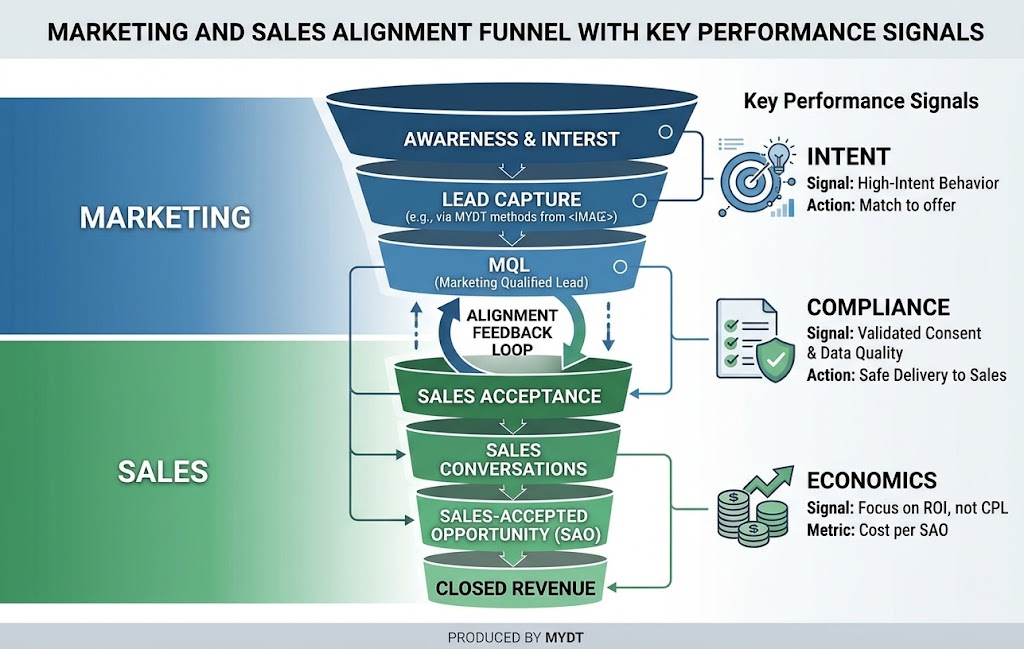
Design
- One offer path, one sales pod, one pipeline definition
- Volume cap + calendar window in writing
- Rejection codes agreed in advance
- Fast disposition feedback (daily or 3x weekly)
Read
- Contact and conversation rates
- Share that becomes opportunities
- Disqualification reason codes
- Sales time per accepted record
Weak contact rates are not fixed by buying more. Fix source, timing, or definition first. Set a kill switch before launch—for example, pause if contact rate stays below threshold for ten business days. Send disposition summaries to the vendor at least three times per week during the pilot.
Set a kill criterion before the pilot starts—for example, pause if contact rate stays under your threshold for ten consecutive business days. Share disposition codes with the vendor at least three times per week during the pilot. Silence is how bad mix becomes “the new normal.”
Operating Habits That Protect Budget
After the contract is signed, six habits matter more than the pitch deck. Use them as a weekly operating checklist—not another essay.
1. Alignment — Marketing and sales share one pilot scorecard (not CPL-only vs revenue-only).
2. Feedback loops — Dispositions change filters and volume every week.
3. Data hygiene — Validation, duplicates, and credit speed are defined in writing.
4. Contracts — Caps, pilot length, and expansion triggers tied to opportunity rate.
5. Vertical fit — Recent programs in your category, including what failed.
6. Brand & claims — Form/call messaging matches what sales may promise.
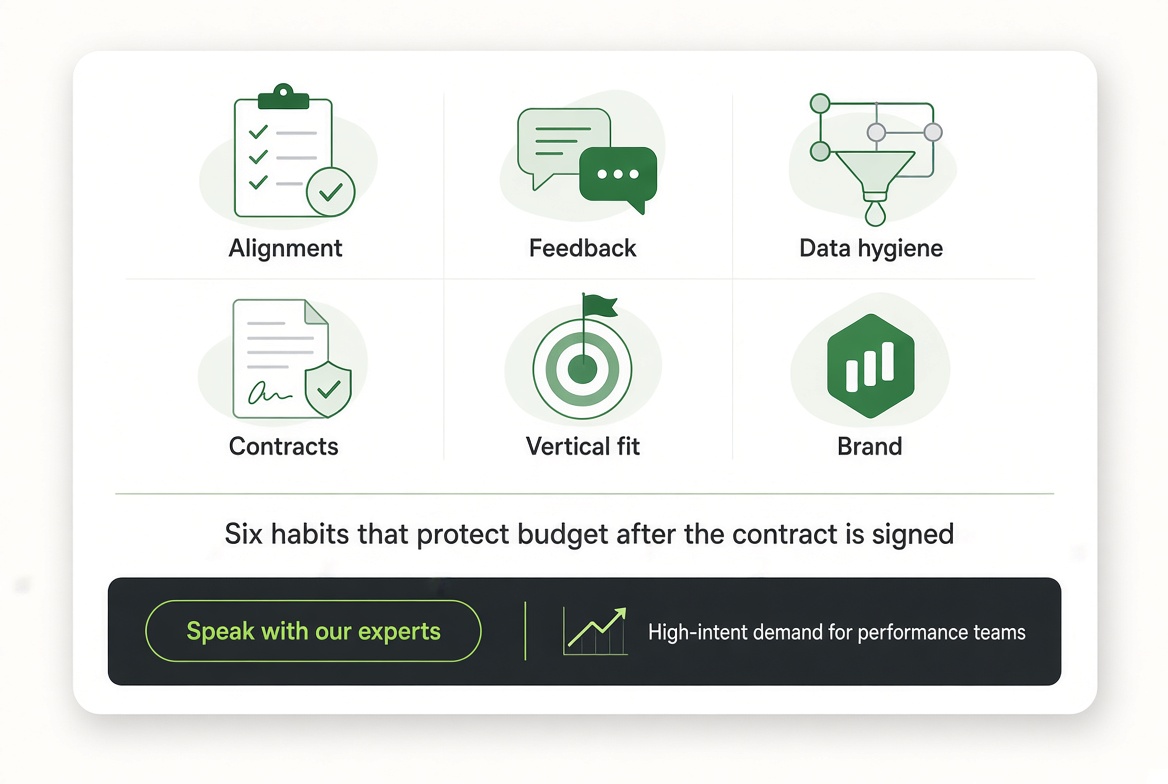
After the contract is signed, these six habits protect budget better than another rate-card meeting.
Alignment
One shared pilot scorecard for marketing and sales—not CPL-only vs revenue-only.
Feedback loops
Weekly dispositions change filters and volume. No feedback = static list machine.
Data hygiene
Validation, duplicates, and credit speed written down—not assumed.
Contracts
Caps, pilot length, expansion only when opportunity rate clears the bar.
Vertical fit
Recent work in your category, including what failed—not “we do everything.”
Brand & claims
Form/call messaging matches what sales is allowed to promise.
Want a partner who runs high-intent demand with these controls in mind?
Speak with MYDT expertsWhere Media DT Fits
Editor’s framing: Media DT is built for performance buyers who need demand that survives the sales handoff—high-intent inquiries and inbound calls, with compliance as an operating constraint.
Strong fit when
- Considered offers (insurance, home services, similar)
- TCPA-aware delivery & documentation
- Optimize to conversations & opportunities
- Willing to define qualification together
Weaker fit when
- Only need cheapest inquiry at max scale
- No feedback loop from sales
- Success = form count alone
- “Lead” definition must stay elastic
Pressure-test us with the same scorecard above. That is the standard we ask buyers to use with Media DT—and with anyone else on the shortlist.
Before You Sign
- Definitions signed by marketing and sales
- Scorecard completed for at least two vendors
- Pilot volume, window, and reject rules in writing
- CRM reporting fields mapped
- Success threshold agreed before scale talk
That is the bar Media DT expects buyers to use with us, and the bar we recommend for every other name on your shortlist. When the checklist is complete, choosing a B2B lead generation company becomes a controlled test—not a leap of faith on a rate card.
Choose the B2B lead generation company that survives this list. Price is the last column—not the first.
What should a B2B lead generation company guarantee in writing?
At minimum: the paid event definition, rejection/credit rules, geography and role filters, exclusivity or share window, and reporting fields. If those stay verbal, disputes are almost guaranteed.
Is a lower CPL always a better vendor?
No. CPL ignores contact rate, opportunity rate, and sales time. Compare cost per sales-accepted opportunity whenever you can.
How long should a pilot run?
Long enough to collect stable dispositions—often a few weeks with a volume cap—not a one-day spike that sales cannot work.
Do we need exclusive leads for B2B?
Not always, but you must know the share rules. Shared delivery changes speed-to-lead requirements and expected contact rates.
When is Media DT a good fit?
When you need high-intent, compliance-aware demand and inbound conversations tied to pipeline—not maximum undifferentiated form volume at the lowest headline CPL.
Talk through your B2B pipeline goals
Media DT helps performance teams source high-intent demand and inbound conversations—so budget follows qualified pipeline, not vanity CPL.
Speak with MYDT experts