
Key Takeaways
- MQL is marketing’s decision that a prospect deserves attention; SQL is sales’ confirmation that the opportunity is real enough to pursue.
- The real difference is sales readiness—engagement alone is not enough.
- Fit, intent, and timing must all be present before a contact moves to SQL.
- A written handoff SLA with accept/reject reasons turns friction into improvement data.
- Measure MQL-to-SQL and SQL-to-opportunity rates, not just MQL volume.
If your marketing team keeps handing over “hot” contacts and your sales team keeps saying they are not ready, you already feel the pain of a broken MQL vs SQL process. One side celebrates volume. The other side burns hours on people who still need nurturing. Revenue suffers in the middle.
This guide clears up the real difference between a marketing qualified lead and a sales qualified lead. You will see practical definitions, the signals that matter, how to build a clean handoff, and the common mistakes that turn pipeline into friction. No jargon for its own sake—just the framework operators use to protect sales capacity and improve conversion.
By the end you will know exactly when a prospect is ready for sales and how to stop the endless “these leads are bad” debate.
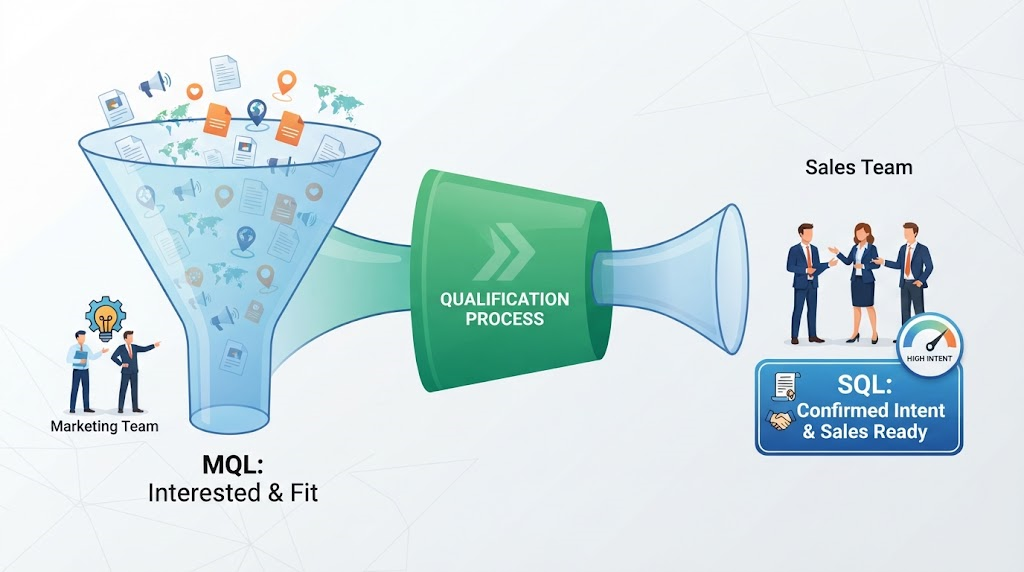
MQL vs SQL: The Core Definitions
A marketing qualified lead (MQL) is a prospect who has shown enough interest and fits enough of your target criteria that marketing believes they deserve continued attention or initial sales review. Typical signals include content downloads, webinar attendance, repeated site visits, or form fills that indicate research rather than immediate purchase intent.
A sales qualified lead (SQL) has moved further. Sales (or an SDR) has reviewed the contact against agreed criteria and confirmed enough fit, need, authority path, and timing to justify direct sales work. The SQL is no longer just “interested”—they look ready for a real conversation.
According to HubSpot’s MQL vs SQL explanation, the fundamental difference is sales readiness: MQLs still need nurturing, while SQLs meet the bar for direct engagement.
In short: MQL is marketing’s routing decision. SQL is sales’ judgment that the opportunity is real enough to pursue.
Key Differences Between Marketing Qualified Leads and Sales Qualified Leads
The gap between the two stages shows up in signals, ownership, and next actions. Here is a practical side-by-side view:
| Aspect | MQL (Marketing Qualified) | SQL (Sales Qualified) |
| Main signal | Engagement + basic fit | Confirmed intent + readiness |
| Typical stage | Awareness / consideration | Decision / evaluation |
| Primary owner | Marketing | Sales / SDR |
| Common actions | Content download, webinar, email engagement | Demo request, pricing ask, consultation |
| Next step | Nurture or sales review | Direct sales conversation |
When teams treat every engaged contact as sales-ready, the SQL stage collapses and sales capacity gets wasted. Clear definitions keep both sides accountable.
How to Score and Transition from MQL to SQL
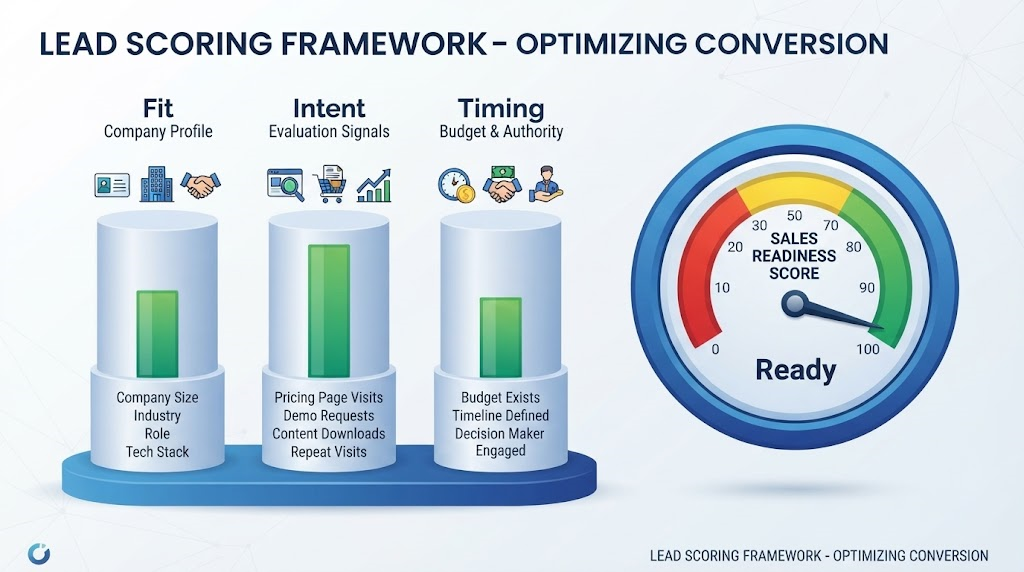
A working MQL-to-SQL process rests on three blocks: fit, intent, and timing. Scoring models that only count downloads produce noise. Models built from closed-won patterns produce pipeline.
Fit Signals
Does the account and contact match your ideal customer profile? Company size, industry, role, geography, and technology stack usually carry the heaviest weight. A high-engagement contact at a poor-fit company rarely becomes a profitable customer.
Intent Signals
Look for actions that show active evaluation: pricing page visits, demo or quote requests, multiple sessions in a short window, downloads of bottom-of-funnel assets, or replies to commercial emails. These signals separate research from buying behavior. Strong lead scoring best practices always weight intent higher than passive engagement.
Timing and Authority
Even perfect fit and strong intent fail if there is no budget window or decision-maker path. Ask or infer whether a project exists, whether a timeline is realistic, and whether the contact can influence or make the decision. Without timing, the lead returns to nurture.
Building a Clean MQL to SQL Handoff
Most revenue leakage happens in the handoff, not in the definition. A written service-level agreement between marketing and sales solves more problems than another scoring tweak.
Essential handoff rules:
- Shared written definitions for MQL and SQL that both teams signed off on
- Clear acceptance window (sales accepts or rejects within an agreed SLA)
- Required rejection reasons so marketing can improve scoring
- Fast-track triggers (demo request, pricing ask) that bypass normal nurture
- Recycle path for valid but early contacts instead of marking them lost
When the handoff is transparent, the “these leads are bad” conversation turns into data-driven improvement instead of blame.

Common Mistakes That Break the MQL–SQL Process
Even teams with good intentions fall into these traps:
- Marketing sets the MQL threshold alone without sales input
- Treating every form fill as sales-ready
- No score decay—old engagement stays “hot” forever
- Measuring success only by MQL volume instead of MQL-to-SQL and SQL-to-opportunity rates
- Ignoring negative scoring (competitors, students, wrong company size)
Fix the process first. More traffic on a broken handoff only multiplies the waste.
Practical Checklist for Aligning Marketing and Sales
Use this short checklist before you scale any lead source:
- Both teams have a written, shared definition of MQL and SQL
- Scoring includes fit + intent + timing, not just engagement points
- High-intent actions (demo, quote, call) fast-track to sales
- Sales has an SLA for accept/reject and documents reasons
- You track MQL-to-SQL and SQL-to-opportunity conversion by source
- Early but valid contacts have a clear recycle path back to nurture
Where High-Intent Sources Change the Game
When your lead source already carries strong buying intent—live inbound calls, tightly filtered exclusive form fills, or verified pay-per-call traffic—the MQL stage often shortens dramatically. Many of these contacts arrive closer to SQL readiness because the consumer has already taken a high-commitment action.
That is why performance teams that combine clear qualification rules with high-intent channels see better sales acceptance rates and shorter cycles. The definition of “qualified” stays the same; the percentage that meets it rises.
Ready for Leads That Sales Actually Wants?
Clear MQL and SQL definitions only work when the upstream traffic is high-intent and properly filtered. If your current sources keep delivering volume that sales rejects, it is time to change the quality of what enters the funnel.
Speak with a team that specializes in real-time, compliant, exclusive lead generation built for conversion—not just form fills.
Ready for high-intent leads that sales actually wants?