
Key Takeaways
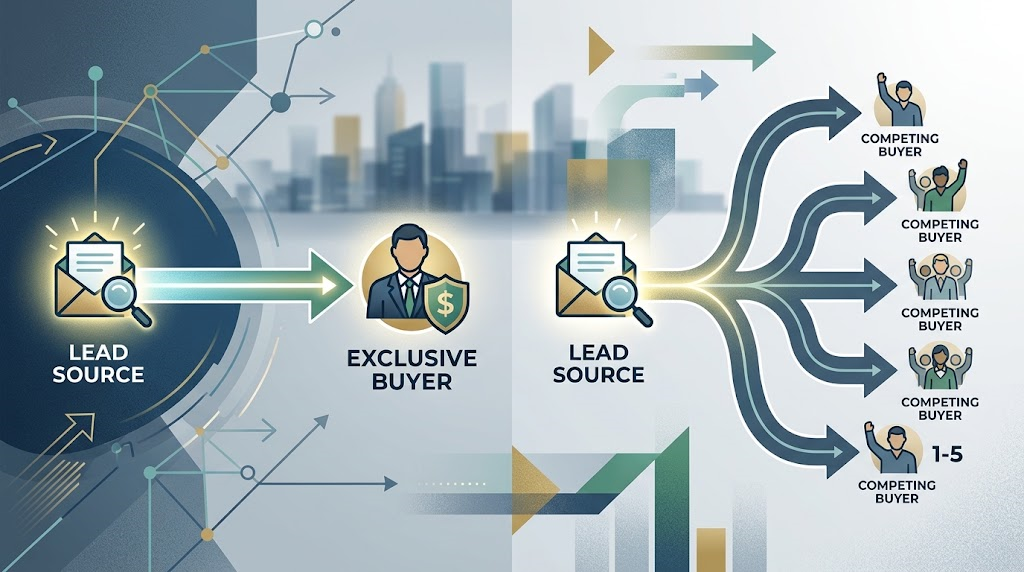
- Exclusive leads go to one buyer; shared leads go to multiple buyers at the same time.
- Exclusive leads usually cost more per unit but often deliver higher contact and close rates because there is no competition.
- Shared leads can work when teams have true speed-to-contact and high-volume capacity; otherwise the low unit price is misleading.
- Compare models on cost per acquisition and sales load, not sticker price alone.
- Many strong programs use a blended mix—exclusive for core high-intent volume and shared for controlled supplemental flow—backed by clean tracking.
If your sales team keeps complaining that “these leads are already cold” or “three other companies called first,” you are probably dealing with the wrong lead type. Understanding exclusive leads versus shared leads is one of the most practical decisions a performance marketer or sales leader can make—because the model you buy directly shapes contact rates, close rates, and cost per acquisition.
Exclusive leads go to one buyer only. Shared leads go to multiple buyers at the same time. The price difference is obvious. The operational difference is even larger. This guide breaks down what each model really means, how they perform in the field, and how to decide which one fits your team’s capacity, vertical, and growth goals.
No abstract theory—just the tradeoffs that show up in real campaigns when you are trying to turn inquiries into revenue without burning through budget or agent time. By the end you will know how to evaluate exclusivity claims, measure true performance, and structure a mix that matches how your sales process actually works.
What Are Exclusive Leads?
Exclusive leads are contact records or call opportunities sold to a single buyer. When a prospect submits a form or triggers a tracked call, that inquiry is delivered to one company only. No other buyer receives the same name, number, or call at the same time.
Because there is no competition for the same prospect, the receiving team controls the first conversation. That usually means higher contact rates, less prospect fatigue, and stronger close rates—especially in high-value verticals where the lifetime value of a customer justifies a higher cost per lead.
Exclusive distribution is the premium product in most lead marketplaces. Buyers pay more per unit precisely because the math of exclusivity improves conversion and reduces wasted dials. For teams that can answer quickly and follow a disciplined process, exclusive leads often deliver a lower cost per acquisition even when the sticker price is higher.
In practice, exclusivity also simplifies accountability. When something goes wrong with a lead—wrong number, low intent, consent questions—there is a single chain of custody. That clarity helps both performance reviews and compliance conversations. It also makes feedback loops faster: if quality drops, you know exactly which source and process to investigate.
Exclusive leads are particularly valuable when your close cycle requires trust and multiple touches. A homeowner shopping for roofing or an insurance shopper comparing policies is more likely to stay engaged when only one professional is guiding the conversation from the start.
What Are Shared Leads?
Shared leads (sometimes called multi-sold or non-exclusive leads) are sold to more than one buyer simultaneously. The same inquiry may go to two, three, or several companies at once. Each buyer pays less per lead, but every buyer is racing the others to reach the prospect first.
Shared models increase total revenue for the generator because the same lead can be monetized multiple times. For buyers, the lower unit price can look attractive on a spreadsheet. In practice, speed-to-contact becomes the dominant variable. Teams that cannot dial within minutes often lose the conversation to a faster competitor, and the effective cost per connected conversation rises.
Shared leads can work in high-volume, lower-ticket environments or for teams that already have strong speed and capacity. They are a poor fit when agent bandwidth is limited or when the prospect is likely to be contacted by multiple parties within a short window.
The hidden cost of shared distribution is prospect experience. Multiple near-simultaneous calls can make a genuine inquiry feel like a spam wave. That perception hurts conversion for everyone who received the lead and can damage brand trust even for the company that eventually “wins.” Over time, that experience also trains consumers to ignore unknown numbers—making the whole channel less effective.
Publishers like shared models because revenue per form fill is higher. Buyers like them when they have surplus dialer capacity and a process built for speed. The friction appears when a buyer assumes “cheap” equals “efficient” without measuring contact and close rates by exclusivity type.
Exclusive Leads vs Shared Leads: Side-by-Side Comparison
The practical differences show up across price, competition, conversion, and operational load.
| Factor | Exclusive Leads | Shared Leads |
| Sold to | One buyer only | Multiple buyers at once |
| Unit price | Higher | Lower per buyer |
| Buyer competition | None | High – speed decides |
| Typical close potential | Higher | Lower due to competition |
| Best fit | High-value, capacity-limited teams | High-volume, fast-follow-up teams |
Price alone never tells the full story. The right comparison is cost per acquired customer and the load on your sales team—not cost per lead on a media invoice.
Why Exclusive Leads Often Convert Better
Conversion differences come from practical factors that show up every day on the phone floor and in CRM outcomes. Understanding them helps you justify premium pricing to leadership and protect budget when someone argues for “cheaper shared volume.”
No Competing Callers
When only one company receives the inquiry, the prospect is not fielding multiple calls within minutes. Fatigue and confusion drop. The conversation starts cleaner, and the sales process is less likely to devolve into a price comparison across several vendors who all received the same lead at the same time.
Sales reps also behave differently when they know they are the only ones with the opportunity. Follow-up is more consistent. Objection handling is more thorough. The urgency shifts from “beat the other three callers” to “help this person solve their problem.” That shift improves both conversion and customer experience scores.

Higher Intent Preservation
Exclusive delivery protects the original intent of the inquiry. The prospect reached out for a reason. Multiple simultaneous contacts can dilute that intent and push the person into defensive mode. Exclusive handling keeps the interaction closer to a solution conversation and farther from a bidding war.
These effects compound in high-ticket verticals. Insurance, home services, and legal practices often see clearer lifts from exclusivity because a single closed job or policy more than covers the premium paid for an exclusive lead. The economics only work, however, when the receiving team can actually capitalize on the cleaner opportunity—which means capacity planning is part of the exclusivity decision, not an afterthought.
When Shared Leads Can Still Make Sense
Shared leads are not automatically “bad.” They are a different product with different requirements. They can contribute useful volume when the operational conditions are right.
- Your team can contact leads within minutes, not hours
- You operate in a high-volume vertical where lower unit cost supports testing and scale
- You already have a mature pipeline and use shared volume as a top-up rather than the primary source
- You have clear internal SLAs and tracking so you can measure true contact and close rates by source
Without speed and capacity, shared leads often underperform relative to their apparent low price. With speed and capacity, they can fill the top of the funnel efficiently. The decision should be driven by operational reality, not by the lowest number on a rate card.
Some organizations also use shared leads for training or overflow. New agents practice on lower-stakes volume while senior closers focus on exclusive opportunities. That structure only works when routing rules and reporting make the distinction visible in daily dashboards. Otherwise the shared volume simply becomes noise that dilutes focus.
Another legitimate use case is geographic or after-hours coverage. If exclusive volume is concentrated in peak hours or core markets, carefully managed shared sources can fill gaps—provided quality filters and consent standards remain consistent.

How to Choose Between Exclusive and Shared Models
Use a simple decision frame rather than a one-size-fits-all rule. The right answer depends on capacity, job value, and how tightly you measure outcomes.
Start with Capacity and Speed
If your agents cannot reliably contact new leads within a short window, exclusive distribution protects you from competing against faster teams. If you already run a high-velocity contact process, shared volume can be absorbed without the same penalty.
Measure actual speed-to-first-contact by source. Many teams discover that their assumed “fast” process is slower than they think once they look at timestamps. That data should drive model selection more than vendor marketing claims. Pair the timing data with contact rate and show-up rate to see the full picture.
Match the Model to Job Value
Higher lifetime value or higher average job size supports exclusive pricing. Lower-ticket, high-frequency work can sometimes tolerate shared economics if contact rates stay healthy. Run the math on cost per acquisition, not cost per lead alone.
Many mature programs run a blended approach: exclusive for core, high-intent sources and shared for supplemental volume. That mix only works when tracking is clean enough to show which sources actually contribute closed revenue. Without that visibility, teams tend to over-allocate budget to the cheaper shared option and under-invest in the exclusive sources that actually close.
Revisit the split when volume changes, when you hire or lose agents, or when a new vertical is added. A model that worked at fifty leads a day can break at two hundred if capacity does not scale with it.
Practical Tips for Buying and Managing Lead Quality
Regardless of model, a few habits separate teams that improve over time from teams that keep repeating the same complaints about “bad leads.”
- Require transparent definitions of “exclusive” and “shared” in every contract—how many buyers, what window, what happens on disputes
- Track contact rate, appointment rate, and close rate by source and by exclusive vs shared tag
- Align agent capacity to expected volume so exclusive leads are not left sitting in a queue
- Review sample consent and delivery practices, especially when combining exclusive form leads with call programs
- Revisit the mix quarterly; what worked at one volume level can break when volume doubles
For broader context on building and managing lead pipelines, established marketing platforms publish practical overviews that remain useful reference points. See HubSpot’s lead generation resources for foundational pipeline concepts, and Salesforce’s lead management overview for how teams operationalize lead handling at scale. Use these as structural references, then apply the exclusive-versus-shared logic to your own vertical and capacity.
The goal is not to pick a single model forever. The goal is to match lead type to team reality so that every dollar of acquisition spend has a clear path to contact and close. When that match is right, both exclusive and shared volume can play a role. When it is wrong, even “cheap” leads become expensive.
Treat exclusivity as a product attribute you actively manage—not a buzzword on a landing page. Ask vendors for hard definitions, test small, measure relentlessly, and expand only what proves out on cost per acquisition and sales team feedback.
Ready for Leads Your Team Can Actually Work?
Whether you need exclusive high-intent opportunities or a carefully structured mix, the right partner designs delivery around how your sales process actually runs—not just how many records can be pushed into a CRM.
Ready for high-intent leads that sales actually wants?