
Key Takeaways
- TCPA compliant lead generation requires valid prior express written consent for marketing autodialed or prerecorded contact, plus strong documentation.
- Buying leads does not remove the buyer’s responsibility; consent quality must still support the intended use.
- Common failure points include weak form language, incomplete records, outdated scrubbing, and slow revocation handling.
- High-intent channels such as pay-per-call remain viable when upstream consent and operational controls are solid.
- Treat compliance as infrastructure—consent capture, scrubbing, retention, and dispute readiness—rather than a one-time checklist.
Buying or generating leads without a clear TCPA strategy is one of the fastest ways to turn growth into liability. TCPA compliant lead generation is no longer a legal footnote—it is a core operating requirement for any program that involves phone numbers, outbound contact, or automated outreach in the United States.
Statutory damages start at $500 per violation and can reach $1,500 when a court finds willful or knowing non-compliance. Class actions multiply that exposure quickly. At the same time, high-intent channels such as pay-per-call and exclusive form leads remain among the most effective ways to acquire customers in insurance, home services, and related verticals. The tension is real: performance marketers need volume and quality, while compliance teams need clean consent trails and defensible processes.
This guide cuts through the noise. It explains what TCPA compliant lead generation actually requires in practice, where programs most often break, and the operational steps that protect both conversion rates and legal standing. The focus is practical—what buyers, publishers, and operators must get right if they want to scale without inviting avoidable risk.

What TCPA Compliant Lead Generation Really Means
At its core, TCPA compliant lead generation means that every phone number collected and later used for telemarketing or automated contact rests on valid prior express written consent (or the appropriate lower standard when the contact is not marketing). The consent must be clear, documented, and tied to the specific type of communication the consumer can expect.
The Telephone Consumer Protection Act and the FCC’s implementing rules restrict autodialed calls, prerecorded or artificial voice messages, and certain text practices. When marketing is involved, the consent bar rises. Simply having a phone number on a form is not enough. The process that captured that number must satisfy the statute and the rules that interpret it.
For operators, this translates into three practical pillars: (1) how consent is collected and recorded, (2) how numbers are scrubbed and suppressed before contact, and (3) how the program handles revocation and documentation over time. Programs that treat these as afterthoughts tend to discover gaps only after a complaint or demand letter arrives.
In competitive verticals, the difference between a sustainable acquisition engine and a recurring legal headache often comes down to whether these pillars are built into daily operations or left as aspirational policy language. High-intent leads still convert—compliance determines whether you can keep buying and generating them at scale.

Core Consent Requirements for TCPA Compliant Lead Generation
Consent is the foundation. Get this wrong and every downstream step inherits risk. The standard that applies depends on the technology used and whether the message is marketing.
Prior Express Written Consent Explained
When a business uses an automatic telephone dialing system or a prerecorded or artificial voice to deliver marketing messages, prior express written consent is required. In practice this means a written agreement—including electronic signatures that satisfy the E-SIGN Act—that clearly authorizes the specific seller to deliver telemarketing calls or texts using those technologies. The disclosure must be clear and conspicuous, and consent cannot be a condition of purchasing goods or services.
The exact language consumers see on a form matters more than many teams realize. Buried or vague “partners may contact you” language has triggered disputes for years. Best practice is to name the entities that may contact the consumer, describe the communication method, and record the full disclosure text, timestamp, IP address, and page URL at the moment of consent. Anything less leaves room for argument about what the consumer actually agreed to.
Operators should also remember that consent given for one purpose does not automatically extend to every possible use. If a form was designed for insurance quotes, using the same number for an unrelated product category can create topical relevance issues that surface in litigation.
Why Documentation Matters as Much as the Checkbox
A checked box without a recoverable record is weak evidence. In a dispute, the business that can produce the exact disclosure language, the time of the action, the source URL, and the consumer’s affirmative step is in a stronger position. Systems that capture only a binary “opted in = true” field leave a gap that plaintiffs and regulators can exploit.
Operators who generate or buy leads at scale should treat consent records as first-class data assets. Retention periods should cover the statute of limitations window with a safety margin. Many compliance-minded teams keep records for five years or longer so that a claim filed near the edge of the limitations period can still be answered with primary evidence rather than reconstruction.
Documentation is also a vendor management tool. When a publisher claims “all our leads are compliant,” the ability to request and review sample consent packages separates serious partners from those who rely on marketing language alone.
Where Lead Programs Commonly Break TCPA Rules
Even well-intentioned programs fail in predictable places. Recognizing these patterns is the first step to fixing them before volume multiplies the damage.
Assuming Purchased Leads Are Automatically Compliant
Buying a lead does not transfer legal risk away from the buyer. Certificates and vendor assurances help, but they do not replace the buyer’s own obligation to ensure the consent supports the intended use. If the original form language or seller identification was inadequate, the downstream caller still faces exposure.
Smart buyers review sample consent language, ask for audit access, and refuse sources that cannot produce clean records. They also align internal dialing practices with the consent they actually hold. Treating a purchased list as a free-for-all outbound opportunity is one of the most common—and expensive—mistakes in the industry.
Weak Scrubbing and Suppression Practices
The National Do Not Call Registry, internal opt-out lists, and reassigned number checks exist for a reason. Calling a number that has been registered on the DNC list, or that has been reassigned to a new consumer, creates avoidable claims. Scrubbing must happen close to the time of dial—not weeks earlier—and suppression lists must be honored promptly when consumers revoke consent.
For official context on unwanted communications, robocalls, and related consumer protections, see the FCC guidance on unwanted communications and TCPA. Programs that ignore these baseline expectations invite both regulatory and private enforcement risk.
Operational Controls That Support TCPA Compliant Lead Generation
Compliance is not a single form change. It is a set of controls that run across the full lead lifecycle—from the moment a number is captured to the moment a campaign is dialed or a lead is delivered.
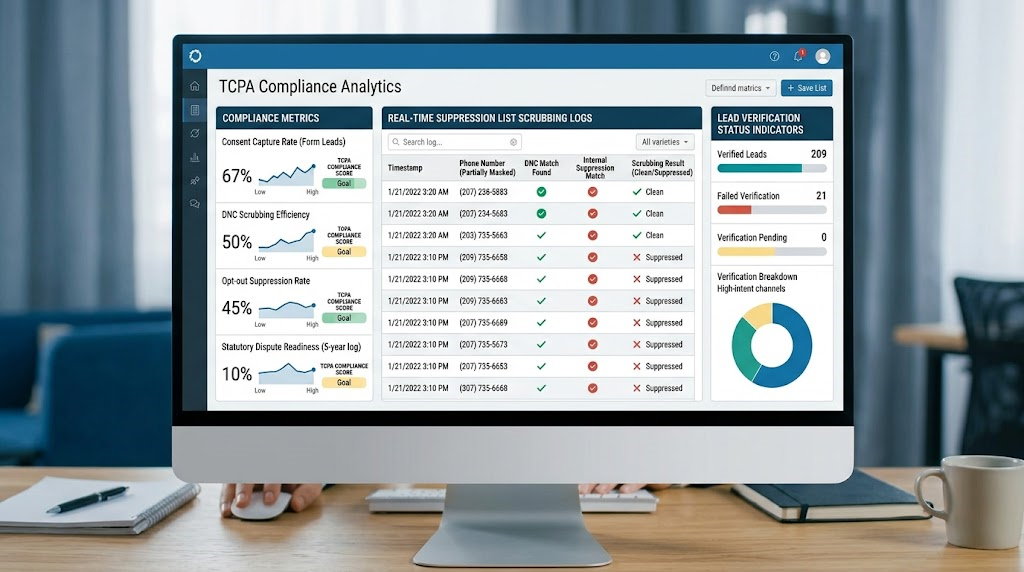
- Consent capture that records full disclosure text, timestamp, IP, URL, and affirmative action
- Seller identification practices that match how the lead will actually be used
- Real-time or near-real-time DNC and suppression scrubbing before dial
- Reassigned number checks where volume and risk justify the cost
- Clear revocation handling with documented response times
- Call recording and retention policies that support later review if a dispute arises
These controls do not eliminate all risk, but they make risk manageable and defensible. Teams that treat compliance as infrastructure rather than a one-time checklist tend to scale more cleanly and face fewer late-stage surprises when buyers or regulators ask hard questions.
Technology helps, but process ownership matters more. Someone on the team must own the consent and suppression stack the same way someone owns campaign performance. When that ownership is clear, gaps get closed before volume exposes them.
How TCPA Rules Interact with High-Intent Channels
Pay-per-call and exclusive inbound leads often sit in a more favorable position than pure outbound dialing of purchased data. When a consumer initiates the call, the dynamics of consent and contact change. That does not mean the channel is regulation-free, but the risk profile is different from autodialed marketing campaigns that push calls out to lists.
Even so, the upstream generation of the number still matters. Forms that drive call volume must still collect consent appropriately if the same data will later support outbound follow-up or text. Call tracking, recording, and quality filters remain important both for performance and for evidence if a dispute arises later.
Operators who mix channels need consistent standards. A strong pay-per-call program can still be undermined if the same organization runs a separate outbound list operation with weaker consent hygiene. Cross-program consistency protects the brand and reduces the chance that a single weak process contaminates the whole acquisition story.
For a broader view of the FCC’s telemarketing framework, including how rules have evolved around robocalls and consumer protections, review the FCC telemarketing rules overview. Understanding the official posture helps teams align internal policies with external expectations rather than relying on informal industry folklore.
A Practical Checklist for Buyers and Publishers
Use this list as a starting point for internal reviews and vendor evaluations:
- Can you retrieve the exact consent language shown to the consumer for any given lead?
- Does the consent identify the sellers or categories of sellers that may contact the consumer?
- Is DNC and internal suppression scrubbing performed close to the time of contact?
- Are opt-out and revocation requests logged and honored within required timeframes?
- Do vendor contracts allocate responsibility for consent quality and provide audit rights?
- Is there a documented process for responding to complaints or demand letters?
- Are call recordings and consent records retained long enough to cover potential claims?
Balancing Performance and Compliance Without Killing Growth
Some teams treat TCPA as a reason to avoid phone-based channels entirely. That is usually a false choice. High-intent inbound calls and carefully consented exclusive leads continue to deliver strong conversion rates in competitive verticals. The difference between programs that thrive and programs that stall is often operational discipline rather than channel selection.
Invest in clean consent capture at the source. Prefer partners who can demonstrate transparent processes and recoverable records. Match contact methods to the consent you actually hold. And treat suppression and revocation as ongoing systems, not occasional clean-up tasks.
When those pieces are in place, TCPA compliant lead generation becomes a competitive advantage: you can scale volume with fewer disputes, stronger buyer confidence, and a clearer story when questions arise from partners, auditors, or consumers themselves.
Growth and compliance are not opposites. Programs that ignore one in favor of the other eventually pay for the imbalance—either in lost volume or in legal and reputational cost. The operators who treat both as non-negotiable are the ones still scaling years later.
Build Lead Programs That Convert and Stay Compliant
Understanding the rules is necessary. Working with partners who design for both performance and compliance is what turns that understanding into results.
Ready for high-intent leads that sales actually wants?