
Key Takeaways
- Performance UA in 2026 rewards precision over volume: high-intent demand, cleaner measurement, and compliant contact practices.
- Compare channels only on the same outcome definition, the same time window, and the same source attribution rules.
- Omnichannel reach, data-informed creative, and backend outcome tracking matter more than any single traffic source.
- Average CPA and target CPA are different ideas—platform metrics are not a substitute for campaign economics.
- Sustainable scale pairs high-intent leads with TCPA-aware delivery and honest LTV thinking—not first-sale vanity.
User acquisition is getting more expensive. Auction pressure, privacy changes, and creative fatigue mean that the same dollar of media buys less attention than it did a few years ago. The teams that stay profitable treat performance UA as a system—targeting, creative, measurement, and compliance working together—rather than as a single channel bet.
As we move through 2026, refining traffic strategy is no longer optional. Companies that still optimize only to clicks or raw form volume discover the gap when finance asks for cost per customer and lifetime value. Media DT works inside that reality: AI-assisted optimization, multi-channel integration, and infrastructure built for high-intent, accountable growth.
This article maps the evolution of performance user acquisition, the strategies that still work, how to make channel results comparable before you reallocate budget, and why high-intent demand plus compliance discipline is the practical path to scale. The tone is operational—built for marketers and operators who need decisions they can defend.
The Evolution of Performance UA
Performance UA used to tolerate blunt instruments: broad targeting, aggressive volume, and post-hoc cleanup. That era is ending. Costs rise when everyone competes for the same generic attention. Privacy and platform rules limit the easy identity graphs that once powered cheap retargeting. Consumers ignore repetitive creative.
The response is not “spend more.” The response is better selection: who is actually in-market, which creative earns attention without lying, which channels produce customers rather than activity, and which contact practices keep the brand out of regulatory trouble.
AI-driven optimization helps when the objective is clear and the feedback loop includes real outcomes—not only platform-reported conversions. Multi-channel integration helps when each channel is measured on a shared definition of success. Neither tool fixes a team that still confuses early signals with long-term value.
Lead-generation verticals feel this shift sharply. Insurance, home services, and other high-consideration categories pay for conversations and policies, not for idle clicks. Programs that still buy undifferentiated traffic while competitors buy intent will lose on unit economics even if they win on volume dashboards.
Strategies for Performance UA Success
Three practical pillars show up repeatedly in programs that hold margin as costs rise.
Omnichannel Without Channel Confusion
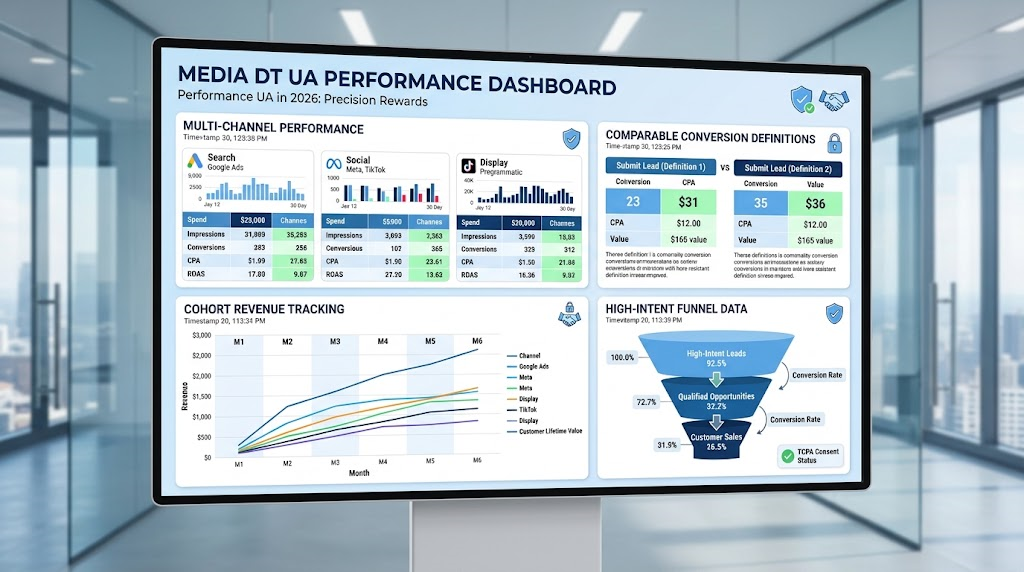
Do not rely on a single source. Combine search, social, and display so you meet the consumer across research and decision moments. Omnichannel fails when each team optimizes a different KPI and nobody owns the customer outcome. It works when search captures high intent, social extends reach and creative testing, and display supports frequency—with one shared scoreboard.

Data-Informed Creative
Crowded feeds punish generic static assets. Video and interactive formats can earn attention when they match the query or moment. “Data-driven” does not mean endless random variation. It means testing against a defined outcome, killing losers quickly, and feeding winning angles back into targeting—not decorating a weak offer with motion.
Backend Optimization Beyond the Click
Track the opportunity past the initial click. Which sources produce qualified conversations? Which produce sales? Which produce customers who stay? Lifetime value (LTV) is not the first invoice. Separate early conversion events from later revenue so you do not crown a channel that only wins the first form fill.
For how intent-focused acquisition is applied in a major vertical, see our strategy piece on
high-intent lead generation for insurance. The same discipline—filter for purchase-phase demand, measure post-delivery outcomes—transfers across performance UA programs.
Make Channel Results Comparable
Before you change a campaign, decide which outcome the comparison should answer: a submitted lead, a qualified conversation, or a sale. A channel that produces more clicks is answering a different question from one that produces more customers.
Keep One Outcome Definition
Compare the same conversion event across the channels under review. If one report counts form submits and another counts qualified calls, you are not comparing channels—you are comparing definitions.
Use a Consistent Window
Record campaign dates and allow the same follow-up period for each group. A seven-day window and a thirty-day window will disagree even when the underlying media is identical.
Carry the Source Forward
Connect the original campaign or channel with later outcomes in your CRM and analytics. Keep untracked outcomes separate rather than guessing their source. Guesswork creates false winners.
Separate Early Signals from Later Value
Review clicks, conversions, and subsequent customer revenue separately. Do not label the first sale as lifetime value. LTV needs time and cohort discipline; first-order revenue is only the start of the story.
When reviewing cost per action, use cost and conversion count for the same scope. Google Ads defines average CPA as conversion cost divided by the number of conversions; a target CPA is a goal, not proof of an achieved result. See
Google Ads: Average CPA definition. Platform metrics inform decisions; they do not replace offer terms or your internal unit economics.
High-Intent Demand and Compliance as Scale Infrastructure
The practical secret to scaling performance UA in 2026 is not a single hack. It is the combination of high-intent demand and contact practices that can survive scrutiny. Volume without intent inflates CPA. Intent without compliance creates a different kind of cost.
High-intent leads—consumers already closer to a decision—improve the odds that media spend turns into conversations and customers. TCPA-aware delivery and documentation protect the right to keep contacting those consumers and to keep partnering with serious publishers and platforms.
Media DT is built around that pairing: infrastructure, traffic, and operational expertise oriented toward accountable performance marketing. We do not treat compliance as theater or intent as a slogan. Both are requirements for durable growth.
For the delivery standard that supports safer contact programs, see
TCPA compliant lead delivery. For the measurement layer that connects calls back to campaigns, see how call tracking works in lead generation.
Stage discipline across the funnel still applies. Resources such as HubSpot’s lead generation guide reinforce clear definitions from inquiry to customer—definitions performance UA teams need before they declare a channel the winner.
A Practical Checklist Before You Reallocate Budget
- Outcome definition is identical across channels in the comparison
- Date range and follow-up window are identical
- Source is carried into CRM outcomes; untracked revenue is labeled as such
- Clicks, conversions, and later revenue are reported on separate lines
- Average CPA uses matching cost and conversion scope; target CPA is not treated as actual
- Creative and audience changes are tested one major variable at a time
- Compliance and consent requirements are confirmed for any outbound contact path
If any item is missing, fix measurement before you “optimize.” Otherwise you will scale noise with higher confidence.
What Media DT Optimizes For
We focus on performance partners who need more than a traffic pipe: clearer intent, multi-channel options, and operating discipline around outcomes. AI-assisted optimization and channel integration are tools. The objective remains profitable acquisition—customers and LTV, not vanity volume.
That means honest constraints. Not every traffic type fits every offer. Not every creative can be forced into every placement. Not every lead is equal. Programs that accept those constraints early waste less budget learning the same lesson in public.
If you are rebuilding UA for a more expensive media environment, start with definitions, then creative and channel mix, then automation. Reverse that order and the automation will efficiently scale the wrong thing.
Finally, treat compliance and brand safety as growth infrastructure. Channels and partners that cannot support clean consent and documentation will become more expensive—commercially and legally—as enforcement and consumer expectations rise. The future favors operators who planned for that early.
Finance and growth teams should share one model: media cost, conversion events, cost per accepted opportunity, cost per customer, and cohort revenue over time. Without that model, performance UA becomes a negotiation between dashboards instead of a managed investment.
When testing new channels, fix the outcome definition first, then the budget, then the creative. Reverse that sequence and you will generate lively reports that still cannot answer whether the channel produced customers.
Privacy and platform policy shifts will continue. Build measurement that does not collapse when a single cookie or signal weakens: first-party capture where appropriate, clear offline outcome imports, and call tracking for phone-heavy funnels. Resilience is a UA feature.
Creative fatigue is structural in 2026, not occasional. Schedule refreshes the way you schedule bid changes. Pair each new concept with clean naming so you can attribute lift or drop. Teams that run the same three ads for a quarter often misdiagnose a “channel problem” that is really an attention problem.
Performance UA also requires organizational honesty about capacity. Buying more qualified opportunities than sales can work simply moves waste from media to payroll. Align budget ramps with hiring, training, and SLA reality. A smaller book of fully worked demand usually beats a larger book of neglected leads.
Put simply: the future of performance UA belongs to teams that buy intent, measure comparable outcomes, protect the right to contact, and scale only what produces customers. Media DT builds programs around that standard for partners who want durable growth in a more expensive media market.
Quarterly strategy reviews should include three questions: What did we learn about intent? What did we learn about creative? What did we learn about measurement gaps? If the review only restates spend and CPA, it is a status update, not a strategy session.
AI assistance should sit on top of clean data and clear objectives. Models trained on noisy conversion labels will efficiently pursue the wrong target. Invest in labeling quality—what counts as qualified, what counts as customer—before you invest in more automation.
Partner selection follows the same logic as channel selection. Prefer networks and agencies that can explain rejection codes, share outcome-level feedback, and accept written definitions of success. Opaque volume is easy to buy and hard to improve.
Vertical specialization still wins. A generic performance UA playbook applied unchanged to insurance, home services, and ecommerce will mis-set expectations on conversion lag, creative depth, and compliance load. Build playbooks per vertical, then share the measurement language across them.
Choose partners, metrics, and processes that match the cost of today’s media. The future is already here for operators who treat performance UA as disciplined investment rather than perpetual volume chase.
Teams that reverse the sequence—scale first, define later—usually fund a expensive education in what not to do. The market in 2026 does not subsidize that education the way cheaper auctions once did.
Start with definitions this week if you have not already: one primary conversion event for channel comparisons, one follow-up window, and a CRM path that preserves source through to customer. Then audit creative and compliance. Then expand budget. That sequence is how performance UA stays profitable when attention is expensive.
Build toward that bar deliberately—one definition, one test, one channel decision at a time—and performance UA becomes a durable advantage instead of a rising cost center.
That is the bar Media DT holds itself to: clearer intent, comparable measurement, and infrastructure that supports scale without discarding compliance or customer value.
The operators who do that will still be scaling when others are only explaining last quarter’s CPA.
Ready to Build Performance UA That Holds Margin?
The future of performance UA belongs to teams that measure the same outcomes across channels, buy intent instead of accidents, and treat compliance as infrastructure. Media DT is built to support that standard with traffic, tooling, and expertise oriented to real growth—not decorative dashboards.
Ready for high-intent leads that sales actually wants?