
- LSA ads are Google Local Services Ads for eligible local home-service demand.
- They fit teams that answer fast, staff the real service area, and track booked jobs.
- LSAs complement search and partner programs; they do not fix weak operations.
- Judge success on cost per booked job and dispute patterns—not lead price alone.
- Media DT helps when you need high-intent volume beyond a single Google surface.
LSA ads—Google Local Services Ads—show local service businesses to people searching for help nearby. For many home-service categories they bill closer to a lead model than a pure click model, which changes how you budget and staff.
This article answers when LSAs fit a home-services operation, what to set up before you spend, and how to compare them with search and partner-sourced demand without rewriting a full marketing encyclopedia.
What Local Services Ads Are (In Practice)
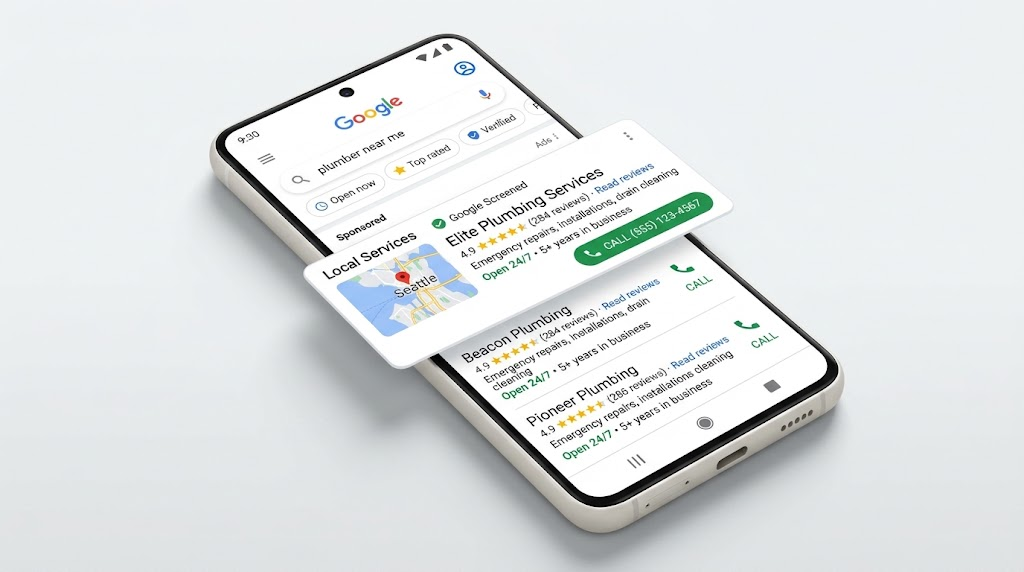
Local Services Ads appear for supported local service searches and emphasize business identity, reviews, and a path to contact. Availability and exact formats depend on category and market. Google documents product behavior, eligibility, and billing in its Local Services Ads help center. Use that as the source of truth for account rules; this playbook focuses on operator decisions.
Unlike a generic search campaign you fully control with keywords, LSAs sit in a more structured local product. Your levers are profile quality, service area, job types, budget, responsiveness, and how you handle the leads that arrive.
When LSA Ads Fit Home Services
| Situation | LSA often fits | LSA is weaker |
| Job mix | Local service calls you can run this week | Complex projects sold only via long consults |
| Coverage | Clear service area you staff daily | Huge radius you cannot answer or serve |
| Response | Phone and message coverage during buy hours | Leads sit overnight with no owner |
| Proof | Licenses, insurance, reviews in order | Profile incomplete or disputes frequent |
| Goal | Booked jobs from local demand | Cheap contacts for a distant CRM experiment |
If three or more “fits” rows match your shop, a controlled LSA budget is rational. If response and area are broken, fix operations first.
Setup Checks Before You Raise Budget
Profile and eligibility
Complete business information, service categories, and required verifications for your trade. Incomplete profiles waste impressions and invite low-quality outcomes.
Service area honesty
Only include zips or cities you can reach on a normal schedule. Overstating area creates leads you will dispute or fail—both hurt economics.
Messaging and hours
Align hours and response expectations with real staffing. Paying for leads you cannot answer is not a media problem; it is a capacity problem.
Tracking
Log every LSA lead in the same system as search and partner leads. Tag source clearly so cost per booked job is comparable.
How to Judge LSA Performance
Do not stop at lead count or average lead cost.
- Contact rate (answered / messaged successfully).
- Booked jobs from LSA.
- Show rate and close rate.
- Cost per booked job.
- Dispute rate and reasons.
A lower lead price with poor contact and no-shows can lose to a higher lead price that books. If contact rate is low, fix response before you negotiate media. No channel looks good when the phone rings out.
Build a simple weekly table: leads, contacted, booked, closed, spend. Share it with whoever answers the phone. Numbers beat opinions when budgets get tight.
The same booked-job lens applies across home-services channels—see lead generation for home services for the broader framework.
LSA vs Search Ads vs Partner Leads
Use each for what it is good at:
- LSA: local service intent with Google’s local packaging and lead-style billing where applicable.
- Search ads: broader keyword control, testing, and offers you need to message precisely.
- Partner / high-intent programs: volume and vertical specialization when Google surfaces are not enough or not available.
Many operators run LSA and search together. Cut the weaker unit on cost per booked job after a fair window—not on first-week nerves. For high-CPC trades such as HVAC, pair channel choice with close discipline from HVAC leads generation and closing practice.
Operational Habits That Make LSA Worth It
- Answer or return messages inside your stated window.
- Confirm job type and location before dispatching.
- Dispute only with clear, documented reasons—not as a default margin tactic.
- Review weekly: which job types from LSA actually close.
- Pause categories you cannot staff instead of collecting junk.
LSAs reward businesses that behave like reliable local operators. They punish slow follow-up.
Budget and pacing without drama
Start with a weekly cap you can staff. Raising budget before answer rates are stable only multiplies unanswered demand.
Compare LSA cost per booked job against search in the same service area and week. If one channel wins clearly, shift gradually—keep a minimum presence on the other while you confirm seasonality. Weather and emergency spikes change both lead flow and close rates. Re-read unit economics after a heat wave or freeze; do not lock annual conclusions from a quiet month.
Common failure patterns
Service area drawn for “more leads” instead of real drive time. Result: high dispute rates and burned CSR time. Multiple locations sharing one messy profile story. Customers call the wrong branch; jobs bounce. Treating every LSA contact as a booked job in reporting. Inflated conversion math hides weak categories.
Turning off search entirely on day one of LSA. You lose control tests and message flexibility you still need for niche jobs.
What to tell sales and dispatch
LSA leads are local shoppers who often expect a fast human response. Script the first minute around job type, address, and timing—not a long brand story.
Give dispatch visibility into which leads came from LSA so route planning and follow-up SLAs stay honest.

Where Media DT Fits Alongside LSA
Google Local Services Ads are one demand surface. Many home-services teams still need additional high-intent volume, call programs, or coverage outside what LSA delivers in their category and market.
Media DT supplies high-intent lead generation and inbound calls with explicit geo and job filters. Use LSA where it books profitably; use partners where you need controlled volume Google does not fully cover. Strong fit for Media DT when LSA alone cannot fill the board to capacity or when call-first demand is central to how you sell.
LSA Go / No-Go Checklist
- Category and market supported.
- Profile complete; licenses and reviews credible.
- Service area matches real coverage.
- Answer path staffed during spend hours.
- Booked-job tracking in place.
- Budget capped for a two- to four-week read.
If the checklist fails, do not “test” with a large budget. Fix the gaps first. Revisit the checklist monthly. Reviews, staffing, and categories change; an LSA setup that worked in spring can drift by peak season.
When disputes cluster around one job type, pause that category before you pause the whole account. Precision beats a full blackout. Keep screenshots or exports of weekly lead and book counts so platform UI changes do not erase your history.
Fit the Product to the Shop
LSA ads work when local intent, honest coverage, and fast response meet. Measure booked work, then decide how much budget LSA deserves next to search and partner demand.
That decision is operational, not ideological. Run the numbers for your trades and your map.
Then scale only what still books after the next busy week in your market.
Everything else is optional.
Explore high-intent lead and inbound programs with Media DT.
Bring LSA booked-job costs and coverage gaps to that conversation so partner volume fills real holes instead of duplicating what already works.
What are LSA ads?
Google Local Services Ads for supported local service categories—structured local placements that often bill closer to leads than pure clicks.
Should I turn off Google Search if LSA works?
Not on day one. Compare cost per booked job over a fair window, then shift gradually.
Why do LSA leads feel “bad”?
Often overstated service area, slow response, or job types you do not actually run—not only the product itself.
What metric matters most?
Cost per booked job, plus contact rate and dispute reasons by category.
How does Media DT fit with LSA?
As additional high-intent and inbound call volume when LSA alone cannot fill capacity or cover needed job types.
Need demand beyond one Google surface?
Media DT delivers high-intent leads and inbound calls with clear geo and job filters—so you can fill capacity LSA and search do not fully cover.
Explore high-intent programs with Media DT