
- High-ticket affiliate marketing prioritizes payout size and buyer intent—not click volume alone.
- Recurring SaaS commissions and one-time high bounties need different traffic and sales support.
- Vet refund windows, cookie length, attribution rules, and creative rights before scaling spend.
- Test small, track approved earnings separately from pending, and kill offers that fail the math.
- Media DT helps publishers access performance offers—including higher-value verticals—with clear tracking.
Most affiliate disappointment starts the same way: strong click numbers, weak approved earnings. High-ticket affiliate marketing exists to change that math. Instead of chasing pennies per click, publishers focus on offers where a single qualified action can justify serious media cost—if the traffic, message, and payout rules line up.
This guide is for performance marketers and publishers who already understand basic affiliate mechanics and want a sharper filter: which high-ticket offers are worth testing, how payout models differ, and how to avoid programs that look rich on a landing page but stall in the backend. It builds on the basics of
If the team is still fuzzy on cookies, postbacks, or EPC definitions, stabilize those basics before increasing bids on high-ticket destinations. Process debt gets more expensive as payout size grows. what affiliate marketing is and pairs with Media DT’s approach to high-converting affiliate programs for serious traffic.
What “High-Ticket” Really Means in Affiliate Marketing
There is no universal dollar cutoff. In practice, high-ticket affiliate marketing means the commission or bounty is large enough that conversion rate and sales cycle—not raw traffic—decide whether the offer is viable. A useful rule of thumb: if a single approved conversion can cover a meaningful share of a day’s media spend for a focused campaign, the offer is operating in high-ticket territory for that publisher. Low-ticket programs can still be profitable at scale. High-ticket programs change the operating rhythm—fewer conversions, more scrutiny per click, and slower feedback loops.
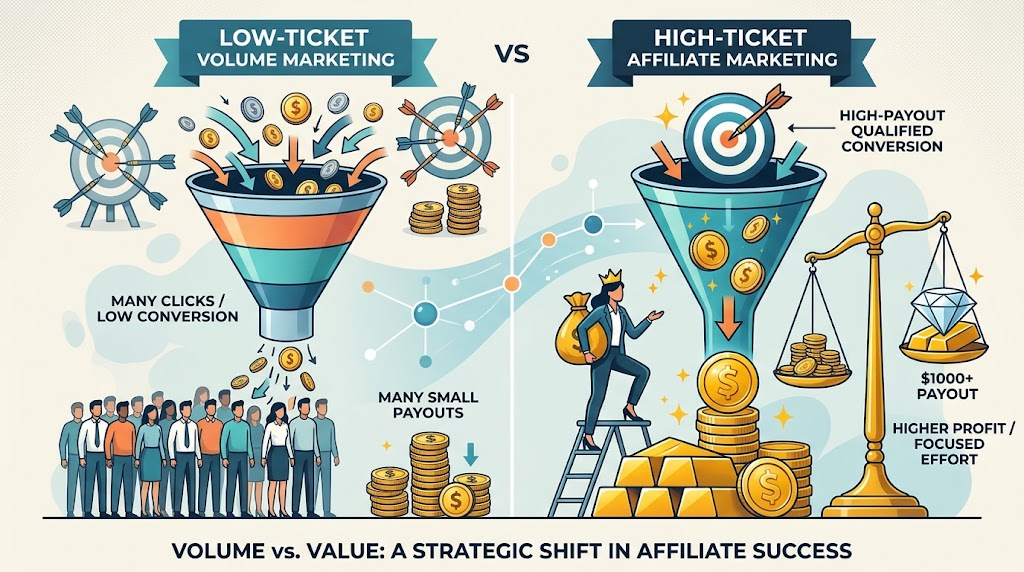
Common patterns include:
- SaaS and software with monthly or annual recurring commissions
- Financial, insurance, or education offers with large one-time bounties
- B2B tools where a qualified demo or trial carries a premium payout
- Service-category offers where a booked call or application pays far above a standard lead CPA
High ticket is not the same as “easy.” Longer forms, sales calls, and credit checks lower conversion. The job is to match traffic intent to that friction—not to pretend friction does not exist. When friction is honest in the pre-sell, conversion rates drop but approval rates and refund rates often improve. High-ticket math cares about the second effect. For SaaS-specific selection criteria, see how to choose SaaS affiliate programs that actually pay.
Payout Models That Change the Math
Recurring commissions
Recurring payouts reward retention. A smaller initial conversion can still win if customers stay for months. Track churn and reversals; a high headline rate means little if refunds erase month two. Model a conservative retention assumption before scaling recurring offers. Optimistic lifetime value is the most common forecasting error in SaaS affiliate plans.
One-time bounties
Large CPAs or CPS amounts pay when a defined action clears. Cash flow feels better early, but quality bars and compliance reviews are often stricter. Pending periods matter. Ask how long conversions stay pending and what evidence triggers approval. Ambiguous pending states freeze budget decisions.
Hybrid structures
Some programs combine a front-end bounty with a residual. Read which event triggers each payment and whether both can reverse. Hybrid deals look attractive in decks. In spreadsheets, they require two tracking truths and two clawback clocks. Miss either and EPC is fiction. Always separate pending earnings from approved earnings in reports. Comparing offers on pending totals is how teams overstate EPC.
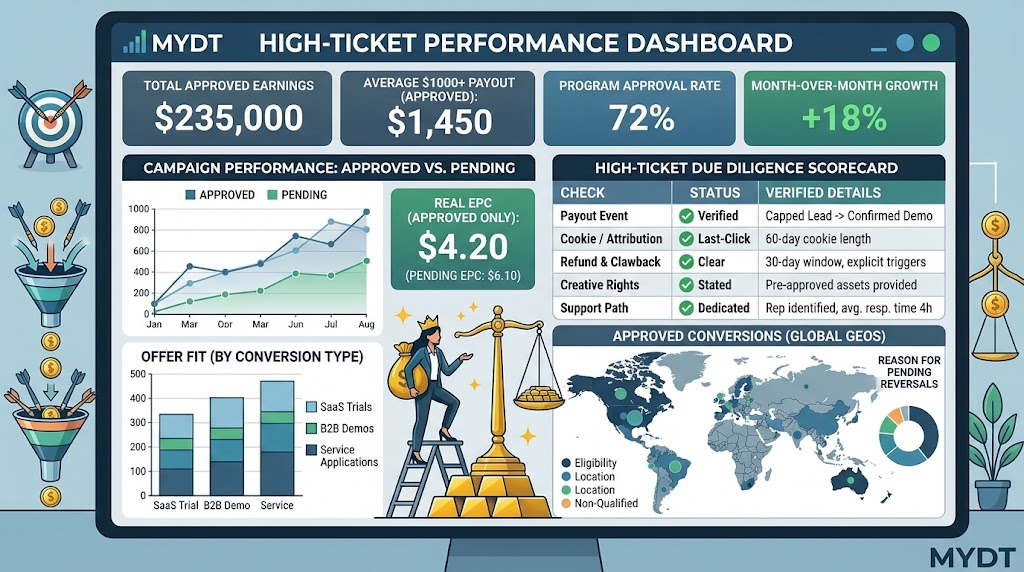
Build a weekly habit: export pending versus approved, note reverse reasons, and recalculate effective EPC on approved only. That single discipline prevents most “this offer died overnight” surprises. If a program’s approval rate is chronically low for your traffic type, the issue is fit—not a temporary backend delay.
Offer Fit: Traffic, Intent, and Sales Friction
High-ticket affiliate marketing fails when cold traffic meets a high-commitment action. Before buying media, map three layers.
1. Intent match
Does the visitor already want the category, or are they only loosely curious? Search and high-intent content usually beat pure interruption for expensive sign-ups. Category-aware audiences reduce sticker shock. Cold audiences need education inventory before the same offer becomes efficient.
2. Friction match
If the offer needs a sales call, the landing path should set that expectation. Surprise phone requirements destroy trust and approval rates.
3. Geography and eligibility
Many high-ticket programs restrict countries, company size, or consumer credit profile. Traffic outside those rules is pure waste. Geo and eligibility checks belong in the media plan, not only in the thank-you page. Upstream filters save the test budget for traffic that can convert. Publishers who treat every offer like a low-ticket impulse buy will mis-price traffic and blame the network. The offer type dictates creative, funnel length, and follow-up.
Content-led publishers often win on high-ticket SaaS when they educate first and pitch second. Media buyers on paid search win when the keyword maps tightly to the paid event. Social traffic can work, but only when the creative sets expectations about price, trial terms, or the need for a sales conversation. Hiding friction in the click is expensive.
Due Diligence Before You Scale
Creative and claims discipline for high-ticket offers High-ticket buyers read carefully. Overstatement that might pass on a low-cost impulse offer triggers complaints, chargebacks, and program removal when the price or commitment is high. Keep a claims sheet: what the advertiser allows, what proof is required, and what must be disclosed. Update it when the program sends new brand rules. On-page proof elements—clear pricing logic, who the product is for, and who it is not for—often improve approval rates more than another headline test. Payment timing and cash-flow planning large bounties may net-30 or longer after approval. Recurring commissions arrive in smaller monthly slices. Plan media cash flow against the slower of the two clocks so scale does not outrun working capital. Publishers who scale on pending balance alone create false confidence. Finance should see approved earnings and historical reverse rates before media budgets jump.
Use a short scorecard on every high-ticket program:
| Check | What to verify | Why |
| Payout event | Trial, paid plan, qualified call, sale | Defines true EPC |
| Cookie / attribution | Window, last-click vs other | Protects assisted conversions |
| Refund & clawback | Days and triggers | Stops false profitability |
| Creative rights | Claims you may make | Compliance risk |
| Support path | Who fixes tracking issues | Saves test budget |
Disclosure rules still apply when you promote offers. The FTC’s Endorsement Guides outline how material connections should be communicated—relevant for reviews, social, and paid landing pages alike.
Testing High-Ticket Offers Without Burning Budget
Start with a capped pilot
Limit spend and geos. Confirm pixels, postbacks, or tracked links fire on the correct event before scaling. A broken postback on a high-ticket offer is more expensive than on a low CPA program because each missed conversion represents a large payout and a large media outlay.
Read approved numbers
Optimize to approved earnings and downstream acceptance—not click-through alone. High CTR with low approval is a creative or traffic-quality problem. Split diagnostics: if users bounce on the first screen, the message is wrong. If they start forms and abandon, friction or trust is wrong. If they convert and reverse, eligibility or expectation is wrong.
Change one variable at a time
Landing angle, audience, or offer—not all three in one day. High-ticket funnels need cleaner experiments because sample sizes are smaller.
Know when to kill the offer
If contact rates, trial starts, or paid conversions stay below the threshold required by your media cost, stop. Switching copy will not fix an eligibility mismatch. Document kill criteria in the same sheet as the offer terms. Emotion-based “one more week” tests are how high-ticket budgets disappear. Network versus platform choice also affects tooling and support. For that structural decision, see some high-ticket advertisers prefer invite-only or managed programs. Application quality, sample traffic sources, and vertical experience matter more than a generic “we have clicks” pitch.
Keep notes on support response times during the pilot. A rich payout with silent tracking support is a hidden cost center. affiliate network vs affiliate platform.
Where Media DT Fits for High-Ticket and Performance Offers
Media DT works with publishers and advertisers who care about measurable performance—not vanity traffic. On the affiliate side, that means access to offers across verticals, clear tracking expectations, and partners who understand that higher payouts demand higher intent.
Strong fit when:
- Traffic can support considered purchases or qualified applications
- Teams are willing to test with disciplined caps and feedback
- Compliance and disclosure are treated as operating requirements
Weaker fit when the goal is only maximum click volume at the lowest CPC with no appetite for funnel work. Comparing high-ticket offers across verticals. Do not rank a SaaS residual against a same-day lead bounty with a single EPC number unless the time window and risk profile match. Different products need different scoreboards. Inside one vertical, compare like events: trial-to-paid against trial-to-paid, qualified call against qualified call. Mixed events create false winners.
When two offers look close, prefer clearer attribution and faster support over a slightly higher headline rate. Operational clarity compounds; a few extra dollars of CPA do not if tracking breaks. Building an internal playbook: After each test, log traffic source, creative angle, approval rate, reverse rate, and the decision to scale or kill. Six months of those notes beat another generic “top offers” list. Share the playbook with new media buyers on the team so high-ticket lessons do not reset every hire.
High-ticket affiliate marketing rewards operators who respect the sales cycle. Media DT’s affiliate programs are built for that performance standard. Publishers working with Media DT can pressure-test offer terms the same way advertisers pressure-test lead quality: clear events, transparent reporting expectations, and room to adjust creative based on real outcomes. That is the standard behind high-ticket work that lasts more than one test invoice.
Practical Checklist Before the Next Test
A final note on expectations: high-ticket affiliate marketing is not a shortcut past funnel work. It is a trade: fewer conversions, higher value per conversion, and more responsibility for message accuracy. Teams that accept that trade—and instrument it with approved-earnings tracking—build portfolios that survive algorithm and policy shifts better than pure low-ticket arbitrage.
Media DT supports partners who want that performance standard across affiliate and complementary acquisition channels.
- Payout event and clawback rules written down
- Tracking verified on a real conversion path
- Creative claims allowed by the program
- Pilot budget and kill criteria set
- Approved earnings reviewed on a fixed cadence
Use the list every time. High payouts do not excuse weak process. Print the checklist for partners who buy media on the publisher’s behalf. Shared process prevents the classic split where media optimizes CPC while the affiliate manager optimizes a different event.
Next Step for Publishers and Media Buyers
High-ticket affiliate marketing works when offer, intent, and tracking align. Choose programs for the action they pay on, test with discipline, and scale only what survives approved-earnings review. That sequence—define, test, approve, scale—is the operating system behind durable high-ticket affiliate marketing.
Explore affiliate partnerships with Media DT.
Bring traffic notes, vertical experience, and the scorecard above to the conversation so offer matching stays concrete. That clarity is the difference between a lucky test and a repeatable channel. Start with one offer, one traffic path, and one success metric—then expand only what the approved-earnings report supports. High-ticket affiliate marketing rewards clarity: clear offers, clear tracking, and clear decisions about what deserves more spend.
What counts as high-ticket affiliate marketing?
Offers where commission or bounty is large enough that conversion rate and sales cycle—not raw clicks—decide profitability. There is no single dollar cutoff.
Are recurring SaaS commissions better than one-time bounties?
Neither is automatically better. Recurring rewards retention; bounties front-load cash. Compare approved earnings, clawbacks, and cash-flow timing for the traffic type.
Why do high-ticket tests fail with “good CTR”?
Often intent or eligibility is wrong, or friction was hidden. High CTR with low approval usually points to message or audience fit—not a need for more volume.
What should be checked before scaling an offer?
Payout event, cookie/attribution, refund rules, creative permissions, and tracking on a real conversion path—using approved earnings, not pending only.
How does Media DT fit?
Media DT works with publishers and advertisers who need measurable performance offers and clear tracking—not vanity click programs.
Ready to test higher-value affiliate offers?
Media DT connects publishers with performance-focused programs—clear tracking, serious verticals, and partners who optimize to approved results.
Explore affiliate partnerships with Media DT