
Key Takeaways
- An affiliate network aggregates many advertisers and publishers under shared tracking and payment rails.
- An affiliate platform (or partner platform) is software or a managed stack used to run one brand’s—or a focused set of—partner programs.
- Networks win on offer breadth and unified reporting; platforms win on control, custom rules, and closer brand–partner relationships.
- The right choice depends on whether you need catalog diversity or program depth—not on which logo is more famous.
- Many serious teams use both: networks for discovery and volume tests, platforms for core high-value partnerships.
Publishers and advertisers hear two labels constantly—network and platform—and they are not interchangeable. Understanding affiliate network vs platform differences saves you from joining the wrong infrastructure, misreading contracts, or blaming “bad tracking” when the real issue is how the system was designed.
A network is typically a marketplace layer: many merchants, many affiliates, shared tools. A platform is more often the engine a single company (or a tight partner ecosystem) uses to recruit, track, and pay its own partners. Overlap exists—some companies blur the line—but the operating implications stay distinct.
This guide clarifies the split for people who already know the basics of affiliate marketing and need a decision framework. If you are still building foundational vocabulary, start with what affiliate marketing is and how it works, then return here to choose where you will actually run programs.
What an Affiliate Network Is
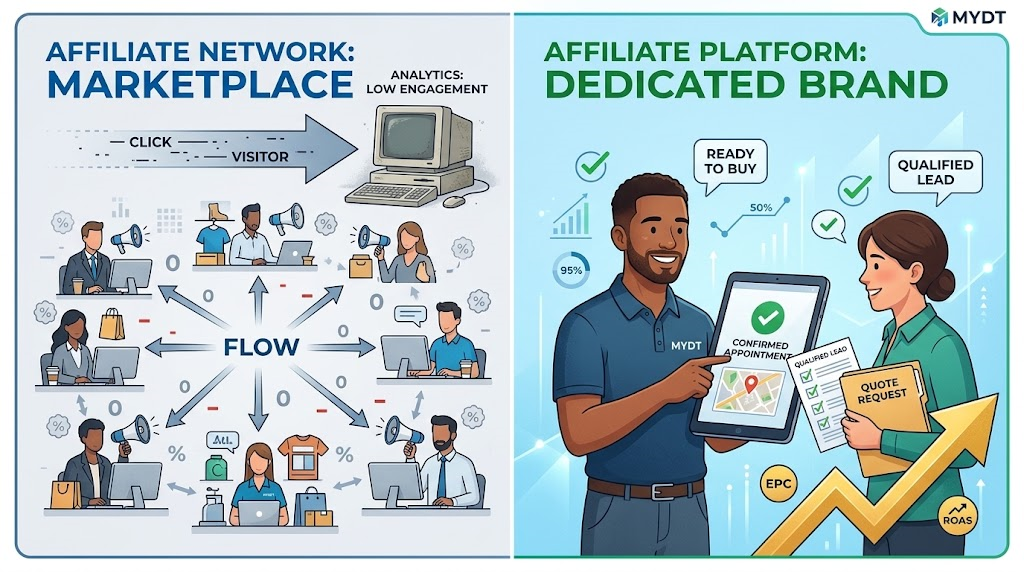
An affiliate network connects advertisers who want performance partners with publishers who have traffic. The network supplies application flows, tracking links, reporting, and often payment aggregation so a publisher can promote multiple offers from one dashboard.
Classic strengths include breadth of catalog, standardized reporting formats, and a single tax/payment relationship covering many brands. Weaknesses can include slower support on edge cases, program rules that vary wildly by advertiser, and less room to negotiate custom terms until you prove volume.
Networks suit publishers who test many verticals or who need a reliable way to discover offers without negotiating every contract from scratch. They also suit advertisers who want reach into an existing affiliate base without building recruitment infrastructure alone.
What an Affiliate Platform Is
An affiliate platform—sometimes called a partner platform or affiliate software stack—is the system used to operate partner programs with deeper control. Brands may run in-house software or subscribe to specialist platforms that handle tracking, tiered commissions, creatives, fraud tools, and partner portals.
Platforms emphasize customization: unique commission logic, gated offers, multi-touch rules, and tighter brand safety. Publishers on a strong direct platform often get higher attention and clearer product education because the relationship is not diluted across thousands of unrelated merchants.
For SaaS and B2B especially, many high-quality programs live on partner platforms rather than general consumer networks. Selection criteria for those offers still matter—see how to choose SaaS affiliate programs that actually pay for commission structure and cookie-window checks that apply whether the program sits on a network or a platform.
Affiliate Network vs Platform: Side-by-Side
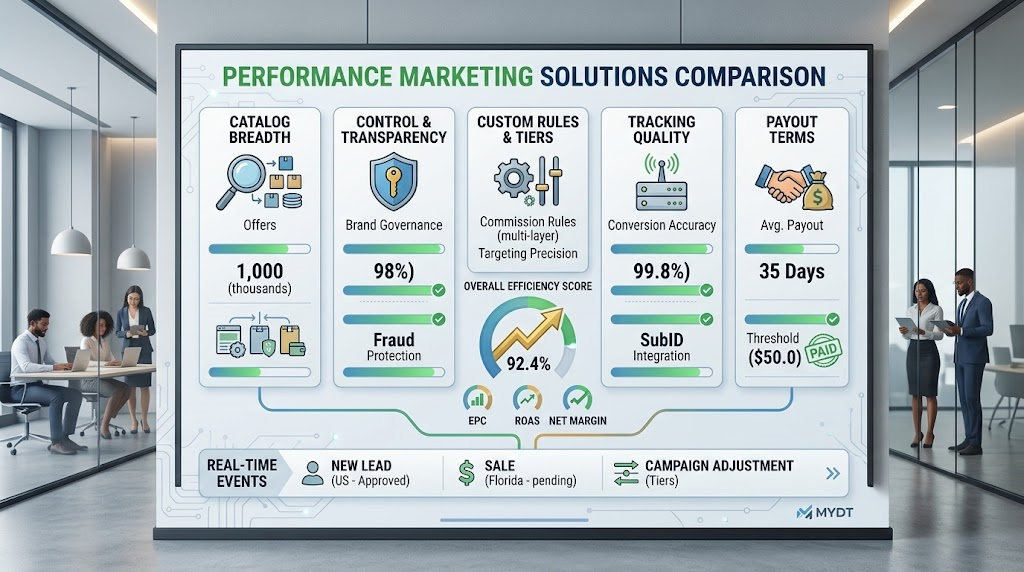
Use this comparison as a practical lens, not a moral ranking.
Offer Catalog
Networks: wide, multi-category. Platforms: narrower, brand- or vertical-focused.
Control and Customization
Networks: advertiser-set rules inside network constraints. Platforms: deeper ability to design tiers, residuals, and partner types.
Reporting and Tracking
Both can track well when implemented correctly. Networks standardize across merchants; platforms may offer richer event models for one brand’s funnel. Always verify subID support and approval workflows.
Relationships and Support
Networks scale support across many accounts. Platforms and direct programs often enable closer account management once you matter to the brand.
Payments
Networks may batch many advertisers into one payout. Platforms pay according to that brand’s schedule and thresholds. Model cash flow either way—do not assume “network” means faster money.
When you evaluate economics, keep publisher earnings separate from advertiser CPA language. The discipline in our CPA marketing and traffic monetization masterclass still applies: approved earnings and defined actions beat headline rate cards.
How Publishers Should Choose
Ask what you need this quarter.
- Do I need many offers to test, or depth with a few core brands?
- Does my traffic require specialized approval (paid search, incentivized, email)?
- Can I pass subIDs and reconcile pending vs approved cleanly?
- Is support responsive when a conversion disputes?
- Do payment terms and lock periods fit my cash cycle?
Discovery-heavy publishers lean network-first. Authority sites in one niche often lean platform- and direct-first. Hybrid is normal: keep a network account for opportunistic tests and reserve primary content inventory for platform programs that convert and pay reliably.
Wherever you promote, audience trust rules remain. Clear disclosures of material connections are expected under guidance such as the FTC’s endorsement guides. Infrastructure choice does not replace honest communication with readers.
How Advertisers Should Choose
Advertisers choosing network distribution gain speed into existing affiliate bases. Choosing a dedicated platform gains control over partner quality, creative governance, and data ownership. Early-stage brands often start on networks for reach; mature performance teams frequently add or migrate core partners onto platforms they control.
Neither path removes the need for clear conversion definitions, fraud monitoring, and fair payment practices. Partners leave systems that reverse earnings without transparent reasons or that change terms without notice.
A Practical Hybrid Approach
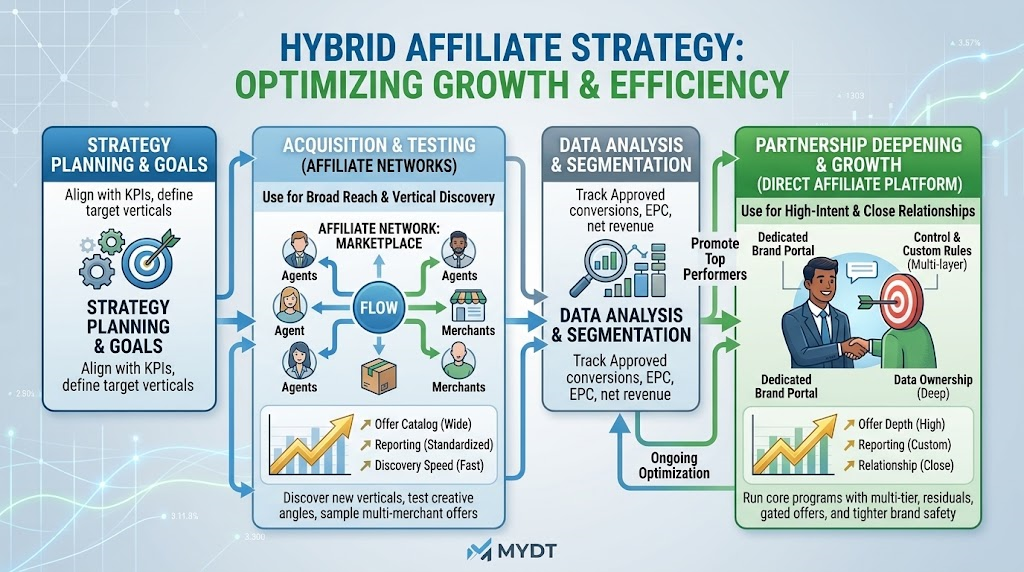
Treat network vs platform as a portfolio decision.
- Use networks to sample verticals and creative angles with limited content cost
- Graduate winners to deeper partnerships—often on platforms or direct deals
- Keep reporting standards identical: approved actions, same date windows, subID discipline
- Review quarterly which systems actually produce net revenue after reversals
Stage thinking still helps across stacks. Practical funnel language from resources like HubSpot’s lead generation guide reminds teams that “lead,” “trial,” and “customer” are different events—map those events explicitly in both network and platform contracts.
Common Mix-Ups to Avoid
- Assuming a famous network always pays better than a smaller platform program
- Joining every network without capacity to maintain quality promotions
- Ignoring brand-bidding and trademark rules because “the network approved me”
- Comparing EPC across systems without matching conversion definitions
- Treating platform access as automatic exclusivity—read the actual agreement
Clear language prevents most of these errors. Write down what you need: breadth, control, speed of payout, or vertical depth. Then match the infrastructure to that need.
None of this means one category is “more professional.” It means the jobs are different. Marketplace aggregation solves discovery and multi-merchant operations. Program platforms solve controlled growth of a partner channel. Choose the job you need done this quarter, then reassess as volume and vertical focus change.
Training content is another differentiator. Strong platforms often supply product education, battle cards, and partner webinars because the brand wants informed sellers. Networks may provide creatives at scale but less product depth. Match that to your content model: educational sites benefit from platform depth; broad media buyers may prefer network speed.
For teams that also buy or sell leads, keep affiliate systems mentally separate from lead-delivery SLAs. Different conversion events, different compliance paths, different dispute processes. Mixing the vocabulary in one spreadsheet creates avoidable arguments between media and finance.
Contract length and notice periods deserve a calendar reminder. Soft commitments feel flexible until an offer disappears mid-campaign. Keep a simple register of programs, lock periods, and contact owners so operations is not surprised when a network merchant pauses or a platform changes tier rules.
Fraud and brand-safety tooling differ by stack. Networks invest in patterns seen across thousands of publishers. Platforms invest in protecting one brand’s reputation and margin. Neither eliminates the need for your own traffic hygiene. If a tactic only works when monitoring is weak, it is not a durable plan on either type of system.
Data ownership matters more as you scale. On networks, historical performance may be harder to export in full fidelity when you leave. On platforms, brands often control deeper CRM-linked events. Publishers who rely on long residual SaaS income should understand how access changes if a program migrates systems.
Tracking quality is not guaranteed by the label on the portal. A network with broken postbacks and a platform with incomplete event mapping both destroy publisher trust. Before you invest serious media, run a controlled test: unique subIDs, known conversion path, and a written note of how long approvals take. Infrastructure that cannot explain pending-to-approved movement is infrastructure you should limit.
In the end, affiliate network vs platform is a tooling and relationship choice inside a larger performance system. Pair it with honest offer selection, clear disclosures, and the same rigor you apply to lead quality. Infrastructure amplifies process—it does not replace it.
Teach your team shared definitions: network, platform, approved conversion, lock period, residual window. Language alignment prevents the same meeting from arguing about “EPC” while people calculate different numerators.
Review your stack twice a year. Offers change, platforms ship new features, and your audience may shift verticals. A setup that was perfect for testing consumer trials may be wrong once you focus on high-ticket B2B residuals. Prune logins you no longer use so reporting stays coherent.
Currency, tax forms, and payment methods sound administrative until they delay a first payout by weeks. Complete profile requirements early on every network and platform you join. Operational readiness is part of professional affiliate work.
Multi-homing—running the same brand on more than one system—can create attribution conflicts if not disclosed. Some advertisers forbid it; others assign priority rules. Ask before you dual-track. Silent multi-homing is a fast way to lose both accounts.
When you negotiate, bring data. Networks respond to consistent volume and clean traffic descriptions. Platforms respond to partners who understand the product and can show content quality. Empty applications that say “I have traffic” underperform applications that show niche, methods, and sample placements.
That measurement habit closes the loop on the affiliate network vs platform question. You stop debating labels and start funding the infrastructure that returns approved revenue after the lock period ends.
Measure success the same way on both: approved actions in a fixed window, net of reversals, relative to traffic cost and content cost. Systems that only look good on clicks are not systems you scale.
If you are a publisher, write a one-page policy for your team: which networks are approved, which platforms are priority, how new offers get tested, and who owns reconciliation. Process beats memory when multiple people touch links.
If you are an advertiser evaluating partners, ask how they work today: mostly network hoppers, mostly direct platform partners, or hybrid. Their answer predicts how they will treat your brand guidelines and how much education they will need.
Finally, stay portable. Build audience equity on your site and list so you are not trapped by any single network or platform login. Infrastructure should serve the audience relationship, not own it.
When something breaks—missing conversions, sudden EPC drops—isolate variables. Was it the network pixel, the platform rule change, your landing path, or traffic quality? Changing everything at once teaches you nothing.
Keep documentation light but real: a living sheet of active programs, system type (network or platform), conversion event, window, and last audit date. Fifteen minutes a week prevents most “where did this link come from” emergencies.
That is the practical answer to affiliate network vs platform for performance teams who care about revenue after reversals, not logos on a login page.
Choose network breadth, platform depth, or a deliberate mix—then hold every system to the same standard of approved results.
Build the habit once, and the infrastructure debate gets quieter every quarter.
Fund what clears approved earnings—and cut what only looks good before the lock period ends.
Ready to Connect Affiliate Infrastructure with High-Intent Demand?
Choosing between an affiliate network and an affiliate platform is an infrastructure decision. Growing a pipeline of high-intent leads and inbound calls for your own sales team is a demand decision. Many performance operators need both conversations working together.
Ready for high-intent leads that sales actually wants?