
Key Takeaways
- Affiliate marketing is performance-based: partners earn when a defined action happens—sale, lead, or call—not for empty traffic alone.
- Three roles drive the model: advertiser (offer), publisher (traffic), and network or platform (tracking and payment).
- Tracking, cookie or click-ID windows, and clear conversion events decide whether commissions are fair and measurable.
- Commission types include CPA, CPC, CPL, and recurring revenue share—compare them on the same basis before you promote.
- Disclosures, offer fit, and approved earnings matter as much as headline payout rates.
If you have ever clicked a review link and bought software—or sent a friend to a service and earned a reward—you have touched the mechanics behind a simple question: what is affiliate marketing and how does it work in practice?
Affiliate marketing is a performance partnership. An advertiser pays a publisher when a visitor referred by that publisher completes a defined action: a purchase, a qualified lead, a trial, or sometimes a phone call. Payment follows results, not promises of exposure.
For publishers and media buyers, the model is a core monetization path alongside lead generation and pay-per-call. For brands, it is a way to scale acquisition with controllable unit economics. This guide explains the roles, the tracking flow, common commission structures, and how to evaluate programs without getting trapped by vanity rates. The focus is operational—built for people who need approved earnings, not just clicks.
Affiliate Marketing Defined in Plain Terms
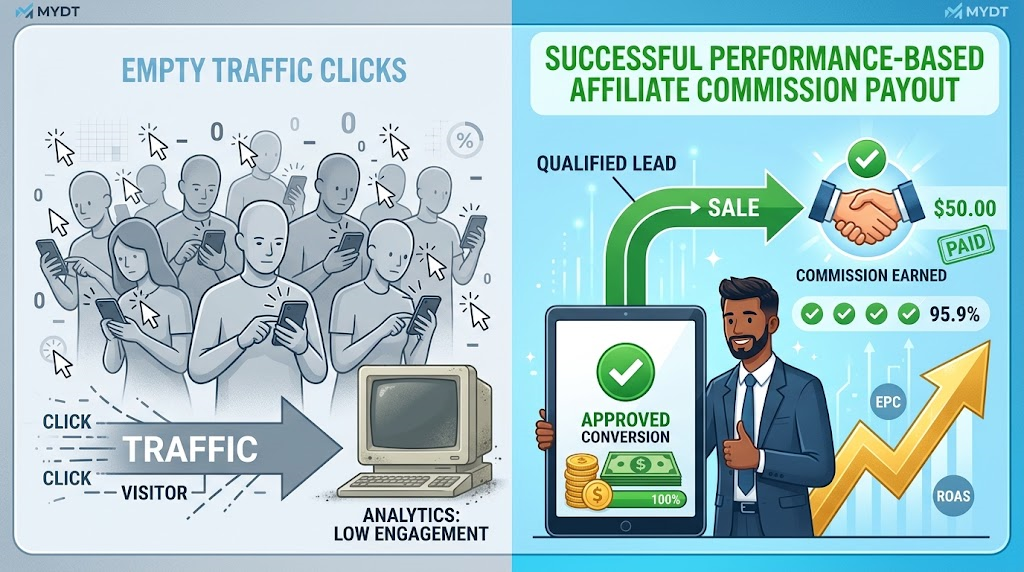
At its core, affiliate marketing is referral-based performance marketing. The advertiser supplies the offer and the payout rules. The publisher supplies traffic and context—content, email, comparison pages, or paid media where allowed. When a referred user converts under the program rules, the publisher earns a commission.
That structure differs from pure brand advertising, where you pay for impressions regardless of outcome. It also differs from buying exclusive leads for your own sales team: in affiliate, you are usually monetizing someone else’s product, not closing the end customer yourself.
The model scales because incentives align when rules are clear. Advertisers pay for actions they value. Publishers invest in traffic that can convert. Problems appear when conversion events are vague, tracking breaks, or traffic quality is misrepresented.
If you already work CPA and EPC math as a publisher, the same discipline applies. Our masterclass on CPA marketing and traffic monetization separates advertiser cost metrics from publisher earnings—skills you need when affiliate dashboards mix pending, approved, and reversed conversions.
The Three Roles That Make Affiliate Work
Every healthy program needs clarity on who does what.
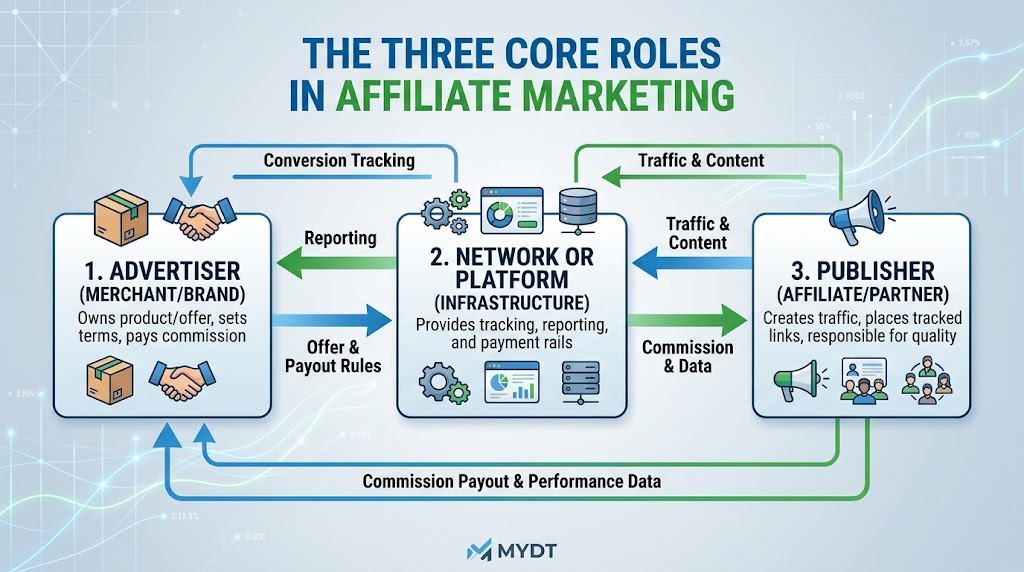
Advertiser (Merchant or Brand)
Owns the product, landing experience, and payout schedule. Sets allowed traffic types, creative rules, and what counts as a payable conversion. Pays commissions when conditions are met.
Publisher (Affiliate or Partner)
Creates or buys traffic and places tracked links or placements. Responsible for disclosures, offer fit, and traffic quality that matches program terms.
Network or Platform
Provides tracking, reporting, and often payment rails. Some advertisers run in-house platforms; others use networks that aggregate many offers. Understanding network versus platform differences helps you pick infrastructure—coverage we expand in the next Day articles in this affiliate sequence.
When roles blur—publishers inventing unapproved claims, advertisers changing terms silently, platforms with weak attribution—trust collapses and so does long-term EPC.
How the Tracking Flow Works
Affiliate marketing only works when the referral can be attributed.
- Publisher places a tracked link, smartlink, or coded placement
- Visitor clicks and is cookied or assigned a click ID
- Visitor converts on the advertiser site or call path within the attribution window
- Platform records the conversion as pending, then approved or rejected
- Publisher is paid on approved volume under the program schedule
Attribution windows vary: seven days, thirty days, ninety days, or longer for high-consideration products. Browser limits can shrink effective cookie life on mobile, so many serious programs support server-side or click-ID persistence.
Always read what event pays. A “sale” is not a “lead.” A “lead” is not a “qualified call.” Mismatched expectations here cause most publisher–advertiser disputes.
Common Commission Models
Normalize before you compare offers.
CPA (Cost Per Action / Pay Per Sale)
Fixed or percentage payout when a purchase or defined action completes. Clear when the action is well defined; painful when refunds reverse a large share of earnings.
CPL and Lead-Based Payouts
Pay for a submitted lead or qualified inquiry. Closer to classic lead generation economics. Quality rules and exclusivity still decide whether the payout is real margin or recycled noise—see exclusive leads vs shared leads for how delivery models change downstream value.
Recurring / Revenue Share
Common in SaaS: a percentage of subscription revenue for a period or for the customer lifetime. Compounds when retention is strong; weaker when churn is high or the residual window is short. For software-specific selection criteria, see how to choose SaaS affiliate programs that actually pay.
CPC and Hybrid
Pay per click is rarer as a pure affiliate model for high-ticket offers but appears in some media partnerships. Hybrids combine a bounty with residual. Compare expected value using your realistic conversion rate—not the program’s marketing page.
How Publishers Should Evaluate an Affiliate Offer
Use a short checklist before you invest content or media.
- Conversion event is defined in writing
- Attribution window fits the real buyer journey
- Traffic types you use are allowed
- Commission model and lock/payment terms are clear
- Creative and trademark rules are workable
- You can pass subIDs and reconcile approved earnings
Test small. Scale only after approved earnings—not clicks—clear your bar. Public rate lists go stale; the partner portal on the day you promote is the source of truth.
Transparency with audiences is part of sustainable affiliate work. In the United States, the Federal Trade Commission publishes guidance on endorsements and disclosures so material connections are clear to consumers—see the FTC’s endorsement guides and related materials. Clean disclosure protects trust and reduces compliance risk.
Affiliate Marketing Alongside Lead Generation
Many performance teams run both. Affiliate monetizes third-party offers. Lead generation supplies opportunities for your own sales team or clients. The shared skill is offer–traffic fit and honest measurement.
Do not blend reporting so thoroughly that you cannot see which engine produces approved value. Separate dashboards keep strategy clear when you decide where to put the next content series or media dollar.
Funnel stage discipline still helps across models. Practical frameworks such as HubSpot’s lead generation guide reinforce clear definitions from interest to customer—definitions you should mirror when an affiliate program pays on “leads” versus “paying customers.”
Getting Started Without the Usual Mistakes
Most affiliate failures are not mysterious. They come from skipping definitions, scaling before proof, or treating the channel like a lottery. Use the following structure to start clean.
Avoid These Early Traps
- Do not chase the highest headline commission without reading the conversion event.
- Do not promote offers your audience will not buy.
- Do not skip disclosures—material connections should be clear to readers.
- Do not scale media or a content series before you have approved earnings data.
- Do not ignore lock periods, payment thresholds, and reversal rates when you model cash flow.
Build a Small, Trackable Foundation
Start with one or two offers you understand deeply. Write useful content or build a clean landing path. Pass subIDs, verify the click-to-conversion path, and reconcile pending versus approved results weekly. Expand only what pays after approval. Niche expertise usually beats thin “best of” pages because recommendations sit inside trusted context.
Paid search, native, and email can work when program terms allow them and brand-bidding rules are respected. Read restrictions before you scale. Protect owned lists—spammy blasts destroy the asset residual commissions depend on.
Operate Like a Performance Channel
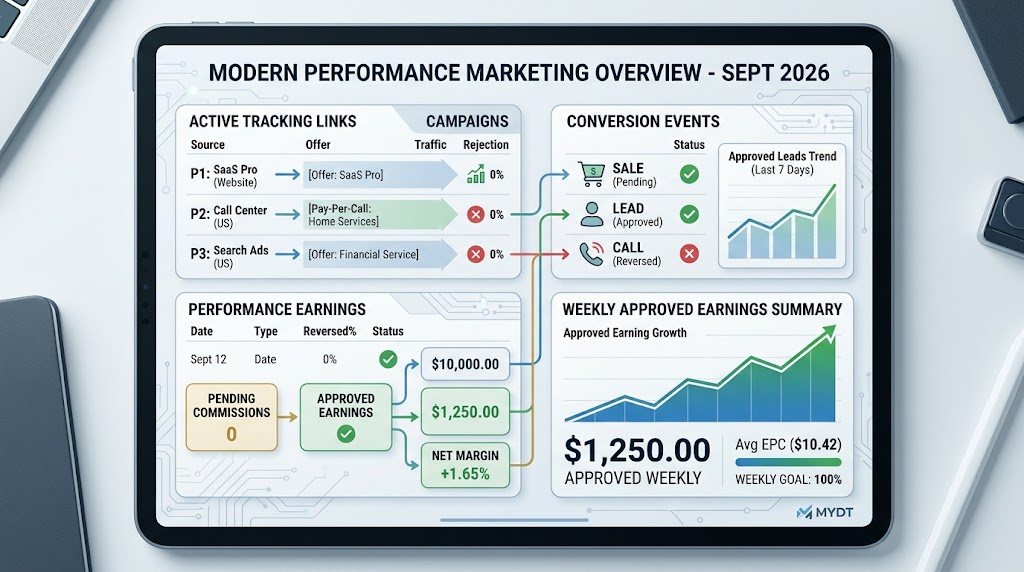
Export approved earnings on a schedule and investigate reversal spikes immediately. Treat network and direct account managers as B2B partners: clear traffic descriptions, no surprise tactics. Change one major creative variable at a time and document tests with dates and subIDs.
Affiliate marketing is active at the start—offer research, tracking setup, content, and optimization. Residuals can become more stable later, especially on retained SaaS, but only after the system is monitored. Keep a small portfolio so seasonality in one vertical does not erase monthly cash flow.
Apply the same standards you use for lead sources: intent, match, capacity, and compliance. When incentives, tracking, and trust line up, affiliate stops looking like a maze of rate cards and operates as a measurable channel you can prune and scale with evidence.
Ready to Pair Affiliate Monetization with High-Intent Demand?
Affiliate marketing answers how partners get paid for referred results. If your broader growth plan also needs high-intent leads and inbound calls for your own pipeline—not only third-party commissions—bring both conversations to the same table.
Ready for high-intent leads that sales actually wants?