
- Lead generation outsourcing works when you define sales-ready criteria, geo, and capacity before you buy volume.
- It fails when the only KPI is the cheapest form fill with no acceptance or credit rules.
- Keep strategy and quality standards in-house; outsource acquisition execution you cannot staff efficiently.
- Score partners on cost per sales-accepted record, not CPL alone.
- Media DT fits teams that want high-intent demand and inbound calls with clear filters—not undifferentiated bulk leads.
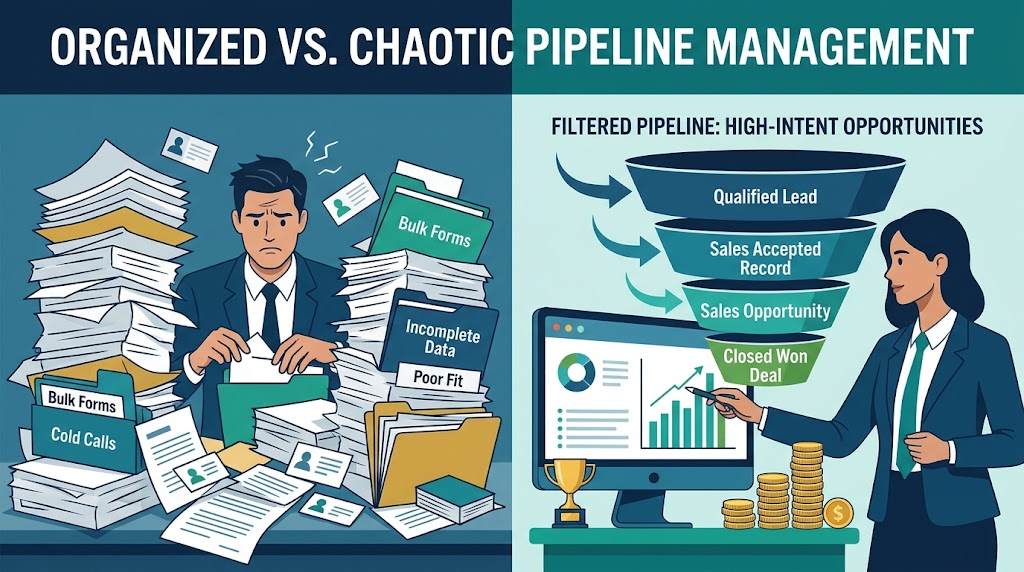
Lead generation outsourcing is a decision about who builds the top of your pipeline. It works when a partner can deliver inquiries your sales team will actually work. It fails when “outsourcing” means buying the lowest invoice cost and hoping sales can fix the mix. This review answers the search intent directly: when outsourcing helps, when it hurts, and how to evaluate a partner without replaying a full lead-definition course.
Quick Verdict
Outsource when you have clear ICP rules, enough sales capacity to respond fast, and a need for scalable acquisition you cannot staff in-house at a sensible cost. Stay in-house or hybrid when your offer is highly consultative, your volumes are tiny, or you cannot yet define what “good” means in writing. Outsourcing chaos only scales chaos.
What Lead Generation Outsourcing Actually Covers
In practice, buyers outsource some mix of:
- Media buying and campaign operations.
- Landing experiences and lead capture.
- Call generation and routing.
- Data validation and basic qualification.
- Delivery into CRM with agreed fields.
You should not outsource the definition of a workable lead or the duty to follow the law on consent. Those stay with your business even when a partner runs the campaigns. For a broad industry view of how lead generation programs are structured, HubSpot’s lead generation guide is a useful primer on goals and funnel stages. Use it for vocabulary—then apply the tighter outsourcing tests below.
Scorecard: Outsource vs Keep In-House
| Dimension | Favors outsourcing | Favors in-house |
| Volume need | Steady pipeline beyond current staff capacity | Low volume, highly custom deals |
| Process clarity | Written ICP, geo, job or offer types | Still discovering who buys |
| Response ops | Sales can hit a first-touch SLA | No one owns speed-to-lead |
| Compliance load | Partner can document consent and filters | You need total control of every claim |
| Unit economics | You can measure cost per accepted opportunity | You only track vanity CPL |
If three or more rows favor outsourcing and you can staff response, a pilot is rational. If clarity and response are missing, fix those first.
When Lead Generation Outsourcing Works
1. You can describe sales-ready in one page
Partners need filters: locations, offer types, disqualifiers, and contact rules. Vague briefs produce vague leads.
2. Sales capacity matches purchased volume
Buying more than your team can call or email on time creates false quality failures. Cap volume to capacity.
3. You measure acceptance, not only price
Track sales-accepted rate and cost per accepted record. A higher CPL with strong acceptance often beats a cheap CPL that sales ignores.
4. You want specialized channels without hiring a full media team
High-intent search, vertical media, and inbound call programs are expensive to staff well. Outsourcing execution can be cheaper than a weak internal attempt. Intent quality still matters after you outsource. For why purchase-stage demand behaves differently, see high-intent leads and why they convert.
When It Doesn’t Work
- No written ICP or geo rules.
- No credit policy for invalid contacts or out-of-area records.
- Sales refuses shared definitions and private “good lead” standards.
- The only goal is maximum forms at minimum CPL.
- Compliance is treated as the vendor’s problem alone.
In those cases, outsourcing amplifies waste. Tighten definitions in-house, then revisit partners. A common failure is outsourcing while sales still invents private rules for “good.” Dispositions will never stabilize, and every vendor will look inconsistent. Another failure is launching three partners in the same week with no control group. You will not know whether results come from source quality or from how the team answered the phone.
Fix internal definitions and response ownership first. Outsourcing is an accelerator, not a substitute for operating basics.
How to Run a Clean Outsourcing Pilot
- Write the paid event and required fields.
- Set a two- to four-week volume cap.
- Agree reject codes and credit rules in advance.
- Hold a weekly review on acceptance and top rejects.
- Expand only if cost per sales-accepted record clears your bar.
Do not renegotiate price before you have acceptance data. Price without quality context is theater.
Hybrid models that often work better than all-or-nothing
Many teams keep brand search and customer remarketing in-house, then outsource non-brand high-intent acquisition or call programs. That split preserves control where identity matters most. Another hybrid: outsource media and delivery, keep final sales qualification and disposition coding internal. The partner supplies volume under rules; your team owns the sales-ready bar. Avoid hybrid setups where two teams change filters in the same week without a shared log. Conflicting changes make every pilot look random.
Red flags in partner conversations
They cannot explain traffic or intent sources in plain language.
They resist written credit rules for invalid contact data or clear out-of-area delivery.
They promise unlimited volume at a fixed low CPL with no talk of acceptance rates.
They treat compliance questions as an annoyance rather than an operating requirement. Any one red flag is a reason to slow down. Two or more are a reason to walk away.
What to put in the first outsourcing brief
Include service or offer list, geo map, excluded job types or verticals, daily or weekly caps, hours of operation, required CRM fields, and the primary success metric. Attach sample rejection codes sales already uses. Partners deliver better when they know how you will score them after week one.
Once you decide to outsource, vendor selection becomes the next job. Use a structured buy-side checklist such as how to choose a B2B lead generation company so the pilot is not based on a sales deck alone.

Where Media DT Fits
Editor’s framing: Media DT is built for performance buyers who outsource acquisition but keep standards in-house—high-intent inquiries and inbound calls, with clear filters and acceptance metrics.
Strong fit when
- Geo, offer, and qualification rules are written down
- Sales can hit a real first-touch SLA
- You optimize to accepted opportunities—not form count alone
- You want high-intent or call-based demand with clean delivery
Weaker fit when
- Only need the cheapest inquiry at max scale
- No feedback loop or rejection codes from sales
- Success = form count / lowest CPL alone
- “Lead” definition must stay elastic and unwritten
Pressure-test Media DT with the same outsourcing scorecard in this article. That is the standard to use with any partner on the shortlist.
Decision Checklist
- Sales-ready definition is written and shared.
- Capacity and first-touch SLA are real.
- Pilot caps, fields, and credit rules are in the contract.
- Success is cost per sales-accepted record, not CPL alone.
- Partner model matches high-intent or call needs if that is your channel.
If the checklist fails, do not outsource yet. If it passes, run a capped pilot and read acceptance data before you scale.
Outsource the Work, Not the Standards
Lead generation outsourcing works when standards stay with you and execution scales with a partner who can meet them. It fails when price is the only filter.
Explore high-intent lead and inbound programs with Media DT. Bring a one-page sales-ready definition and capacity number to that conversation so the first pilot is scored against real operating constraints. Lead generation outsourcing is a management choice. Treat it like any other vendor relationship: clear scope, measurable outcomes, and the discipline to stop when the data says stop.
Standards first. Volume second.
That order is what separates useful lead generation outsourcing from expensive noise.
When does lead generation outsourcing work?
When ICP, geo, and capacity are written down, sales can hit a response SLA, and success is measured on accepted opportunities—not vanity CPL.
When should a team stay in-house?
When volume is tiny, the offer is highly custom, or “good lead” still cannot be defined in one page.
What should a pilot include?
A capped volume, required fields, credit rules, weekly acceptance review, and a clear expand-or-stop threshold.
Is a lower CPL always the goal?
No. Cost per sales-accepted record is the better unit. Cheap inquiries that sales rejects raise true cost.
How does Media DT fit outsourcing?
As a high-intent lead and inbound call partner for teams with clear filters and real response capacity—not as a source of undifferentiated bulk forms.
Ready to outsource with clear standards?
Media DT delivers high-intent lead generation and inbound call programs for teams that define quality up front and measure what sales actually accepts.
Explore high-intent programs with Media DT