
- Digital marketing for home services only works when channels feed bookable jobs in a defined service area.
- Prioritize high-intent search, local presence, and call paths before broad awareness spend.
- Measure cost per booked job or sales-accepted lead, not clicks alone.
- Match volume to dispatch capacity and response speed.
- Media DT supports high-intent home-services demand when geo and job-type filters stay clear.
Digital marketing for home services is not a generic social calendar. Homeowners buy when something breaks, ages out, or must pass inspection. Channels that ignore urgency, geography, and phone behavior waste budget.
This playbook ranks channels by job-booking usefulness, shows how to combine them, and lists metrics that match field operations. It builds on lead-focused tactics without rehashing a full lead-definition primer. For a tighter lead-only view, see lead generation for home services.
What “Good” Looks Like in Home Services Marketing
A working system produces inquiries your team can run: correct zip codes, job types you actually sell, and contact paths that get answered during business hours. Write three constraints before you spend:
- Service area map (include and exclude).
- Job types you will accept this quarter.
- Daily capacity for estimates or dispatch.
Marketing that exceeds capacity creates “bad lead” complaints that are really staffing problems.
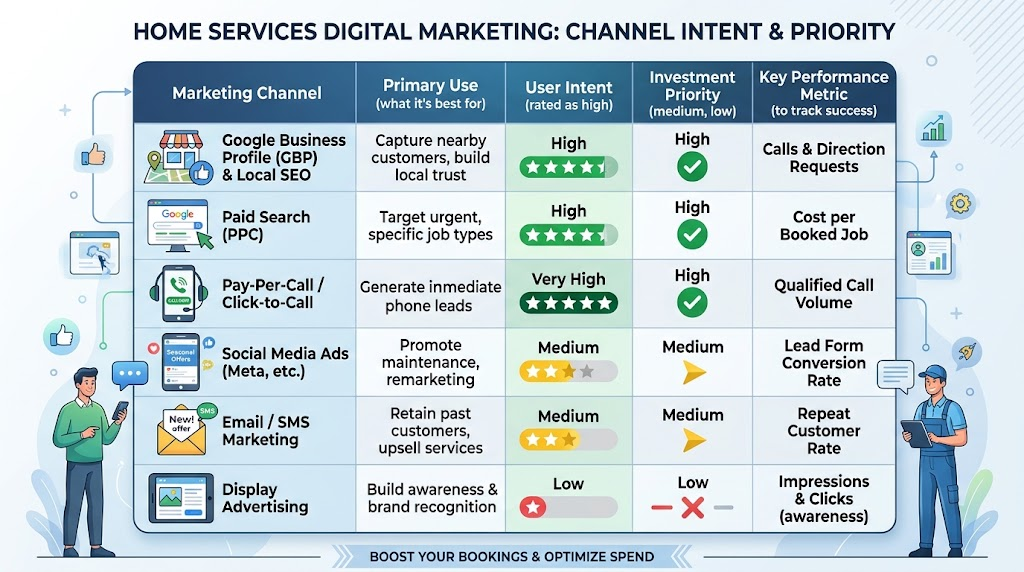
Channel Playbook: Where to Put Budget First
| Channel | Best for | Watch outs |
| Google Business Profile + local SEO | Nearby, high-trust discovery | Weak categories, ignored reviews |
| Paid search | Urgent, high-intent jobs | Broad match waste, wrong geos |
| Click-to-call / pay-per-call | Phone-first homeowners | No after-hours plan |
| Paid social / display | Seasonal offers, remarketing | Cheap clicks, soft intent |
| Email / SMS to past customers | Maintenance and upsell | Consent and frequency rules |
Start with local presence and high-intent search. Add call-focused buying when your phones are staffed. Treat pure awareness media as optional until booked-job cost is stable.
Local Presence: The Non-Optional Layer
For home services, the map pack and profile trust signals often decide who gets the call. Keep categories, service areas, photos, and review responses current.
Google’s documentation for Google Business Profile is the operational reference for how profiles, insights, and verification work. Use it to keep the listing accurate—not as a substitute for paid demand when you need volume. Track calls and direction requests from the profile the same way you track paid calls. Untracked local demand still consumes trucks.
Paid Search and On-Site Conversion
Paid search wins when queries show job intent: repair, install, replace, near me, emergency. It loses when match types and geos are loose.
Search setup rules
- Hard geo fencing to service zips.
- Negatives for DIY, jobs, and wholesale intent you do not serve.
- Separate ad groups for emergency vs planned install when budgets allow.
Landing and call paths
Pages should state service area, job type, and next step in plain language. Phone numbers should be tracked. Forms should ask only what dispatch needs: location, job type, timing, contact. If most customers call, design for click-to-call first. Form-only paths underperform for urgent trades.
Calls as a Primary Channel, Not an Afterthought
Many home-service buyers still prefer the phone. Click-to-call ads and pay-per-call style buying can outperform forms when qualification and staffing are real.
For how payable call products are structured, see what pay per call leads are. Use that lens when you compare call vendors to form vendors on cost per booked job—not on cost per click. Write rules for after-hours: voicemail with callback SLA, answering service, or paid pause. Overnight missed calls become morning “bad lead” reports. Record a sample of calls weekly. Patterns in “just shopping for price” or “outside our area” should change bids and partner filters the same week, not next quarter.
Train CSRs on a short script that confirms zip code and job type in the first minute. Early disqualification protects technician time and keeps channel quality scores honest.
Paid Social and Display: Use With Limits
Social and display can support seasonal maintenance offers and remarketing to site visitors. They rarely replace high-intent search for emergency work. Cap these channels until you can prove cost per booked job, not cost per lead form. Soft-intent volume fills CRMs and starves dispatch.
Metrics That Match Trucks and Schedules
Report weekly:
- Inquiries by channel.
- Sales-accepted or dispatch-accepted rate.
- Booked jobs.
- Cost per accepted inquiry and cost per booked job.
- Median time to first response.
If CPL looks great and booked jobs are flat, marketing is buying the wrong unit. Align channel budgets to booked outcomes. Publish a single dashboard owner. When marketing owns CPL and operations owns booking rate with no shared view, every channel review becomes a blame session.
Review cancel-after-book reasons monthly. High cancels from one source point to expectation mismatch on price, timing, or job scope in the ad or landing path. For multi-location brands, split reporting by branch service area. A strong metro campaign can hide rural waste if numbers are blended.
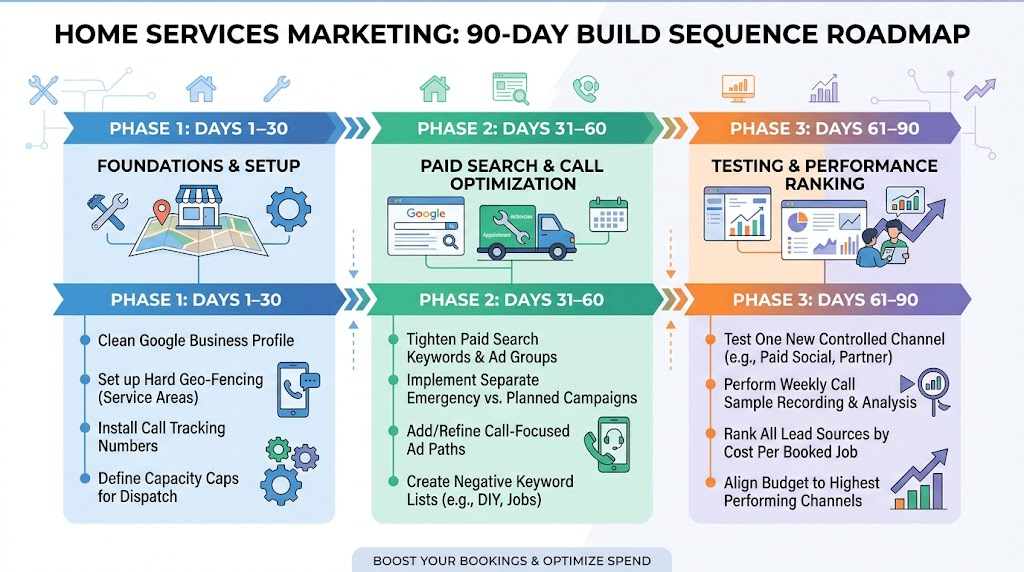
90-Day Build Sequence
- Days 1–30: Clean GBP, geo rules, tracked numbers, capacity caps.
- Days 31–60: Tighten paid search; add or refine call paths; kill waste queries.
- Days 61–90: Test one controlled social or partner source; rank all sources by cost per booked job.
Change one major variable per week. Stacked changes hide what worked.
Creative and offer angles that match home-service intent
Urgent jobs respond to clear problem statements: no heat, leak, safe panel, same-day window. Planned installs respond to financing clarity, timeline, and proof of licensed work. Do not run one generic “best contractor” message across emergency and remodel intent. Split campaigns when budget allows so quality scores and landing pages stay aligned. Seasonal angles work when they match real capacity: filter changes, tune-ups, pre-summer AC checks. Promote only what you can schedule within the promised window.
Partner and marketplace demand
Lead marketplaces and partner referrals can fill gaps if filters match your map and job mix. Score them on booked jobs and cancel rates, not on lead price alone. Require geo, job type, and exclusivity or share rules in writing. Cheap shared leads that five companies dial will look fine on CPL and fail on the schedule board. When testing a new partner, cap volume for two weeks and staff response the same as your best channel. Unequal response times fake quality differences.
Compliance and claims discipline
Only advertise licenses, insurance, and guarantees you can prove. Overstated claims create chargebacks and review damage that paid media cannot repair. Keep consent and contact rules clean for SMS and outbound follow-up. Home-service urgency is not an excuse for sloppy contact practices.
Where Media DT Fits
Media DT supplies high-intent lead generation and inbound call programs for performance buyers, including home-services verticals when geo and job filters are explicit. The fit is strong when you measure accepted jobs and staff the phone. The fit is weak when the only goal is the cheapest possible form fill outside your service map.
Channel Checklist Before You Scale
- Service area and job types written down.
- Local profile accurate and monitored.
- Paid search geos and negatives enforced.
- Calls tracked and staffed.
- Budgets ranked by cost per booked job.
Digital marketing for home services succeeds when every channel respects the map, the schedule, and the phone.
Book Jobs, Not Vanity Metrics
Put budget into intent and response. Keep awareness spend small until unit economics are clear.
Explore high-intent lead and inbound programs with Media DT.
Bring service-area maps and job-type lists to that conversation so demand matches what dispatch can run.
When channels, staffing, and partners share one booked-job scoreboard, digital marketing for home services becomes a controllable system instead of a monthly argument.
Which channel should home-service brands fund first?
Local presence and high-intent search, then call paths if phones are staffed. Broad social usually waits until booked-job cost is stable.
What metric should replace vanity CPL?
Cost per dispatch-accepted inquiry and cost per booked job, reviewed with response speed.
Why do call campaigns fail overnight?
No after-hours owner. Missed calls become “bad leads” by morning even when the source was fine.
How should partner leads be judged?
On booked jobs and cancels under the same response SLA as your best channel—not on lead price alone.
How does Media DT fit home services?
High-intent leads and inbound calls with explicit geo and job filters, for teams that measure booked work.
Need home-service demand that dispatch can run?
Media DT delivers high-intent leads and inbound calls with clear geo and job-type filters—so marketing spend follows booked work, not empty form volume.
Explore high-intent programs with Media DT