- Multi-touch attribution spreads credit across the path, not only the last click or last call.
- Pick one conversion definition and one model before you compare channels.
- Calls need explicit rules: click-to-call, connected call, and qualified call are different events.
- Do not mix pending lead status with closed revenue in the same scoreboard.
- Media DT programs work best when buyers can see source, path, and outcome with consistent definitions.
Multi-touch attribution answers a practical question: when a lead or a call converts after several ads, pages, and touches, which investments deserve budget? Last-click reporting is simple. It is often wrong for considered offers and phone-assisted sales.
This article is for performance teams running both form leads and inbound calls. It focuses on decisions you can implement: which event to count, which model to use, how to treat calls, and how to avoid double counting. It is not a tour of every academic attribution theory.
What Problem Multi-Touch Attribution Solves
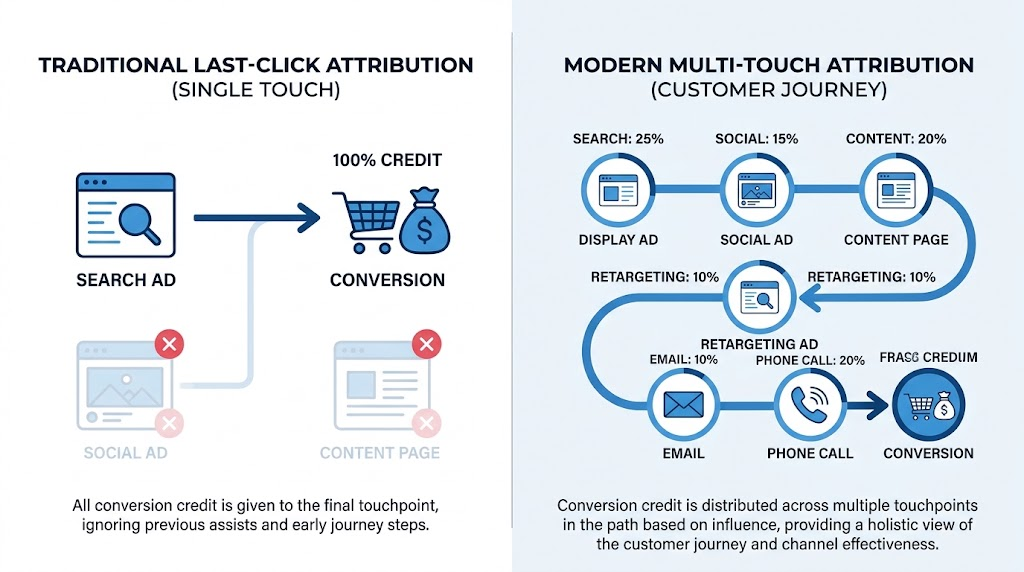
In lead and call campaigns, a single last touch rarely tells the full story. A prospect may click a search ad, return through a retargeting ad, then call a tracked number days later. If you fund only the last event, you underfund the path that created demand.
Multi-touch attribution assigns fractional or rule-based credit across touches in a defined window. The goal is better budget allocation, not a perfect philosophical truth.
If your sales cycle is one click and one form the same day, last-click may be enough. When paths include content, paid social, search, and phone, multi-touch becomes useful.
Lock the Conversion Event First
Attribution cannot fix a fuzzy conversion. Choose the event that matches the business decision:
- Marketing-qualified inquiry.
- Sales-accepted lead.
- Qualified connected call.
- Opportunity created.
- Closed sale.
Report each event separately. Do not average “leads” that mix form fills and five-minute calls into one column and then argue about channel quality.
For call programs, align attribution with how you already measure call value. Practical ROI framing for tracked calls is covered in what call tracking ROI means. Use that outcome definition inside whatever multi-touch model you pick.
Model Choices That Teams Actually Use
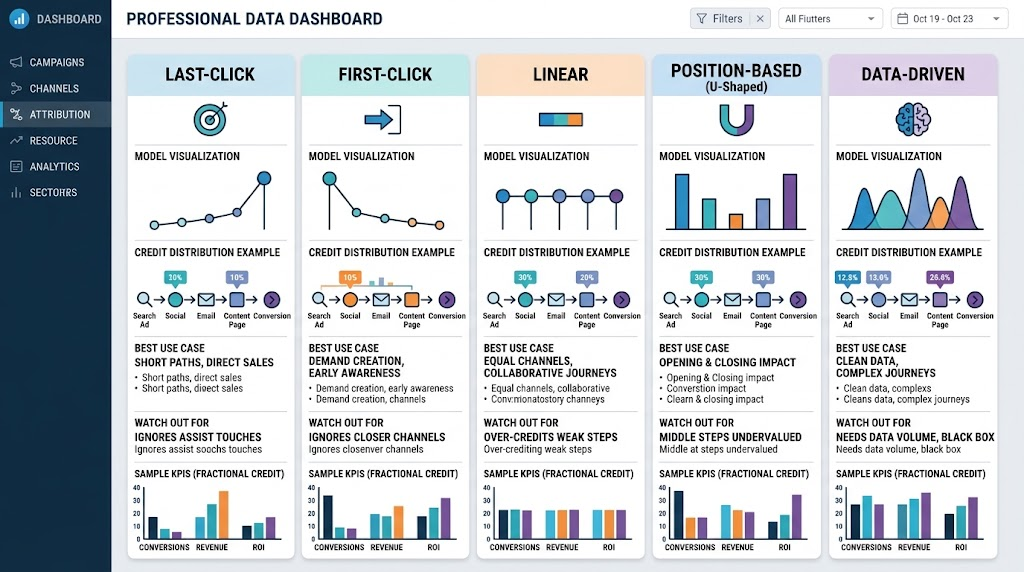
You do not need every model. Start with one primary model and keep last-click as a reference view only.
| Model | Best when | Watch out |
| Last click | Short paths, single primary channel | Ignores assist touches |
| First click | You care about demand creation | Ignores closer channels |
| Linear | Touches are roughly equal by design | Can over-credit weak steps |
| Position-based | You value open and close touches | Middle content gets less credit |
| Data-driven | Enough conversion volume and clean data | Needs volume; black box risk |
Google Ads describes data-driven attribution as using account data to distribute credit across search touches when eligibility thresholds are met. See Google’s overview of data-driven attribution. Platform models still require you to define which conversion action is being attributed.
Pick one model for budget meetings. Changing models every week makes trends meaningless.
Calls Break Simple Web Attribution
Phone paths often leave the browser. If call metadata never returns to the same journey map as clicks, multi-touch reports will understate call-assisted channels or invent gaps.
Define call stages
- Number click or dial.
- Connected call.
- Qualified call under campaign rules.
- Downstream opportunity or sale.
Attribute only the stage you fund. Funding “connected calls” while optimizing to “number clicks” will misallocate spend.
Join call data to the path
Use unique numbers, session parameters, or CRM IDs so a later call can attach to earlier digital touches when the vendor stack allows it. For how tracking supports lead programs operationally, see how call tracking works in lead generation.
Avoid double counting
If a person submits a form and calls the same day, decide whether both events count, or which one is primary. Write the rule down. Silent double counting inflates channel ROI on paper.
A Practical Setup Sequence
- Week 1: Freeze conversion definitions for leads and calls. Map them in ads, CRM, and call tracking.
- Week 2: Choose one multi-touch model plus a last-click reference report.
- Week 3: Validate that sample paths show expected touches and that call outcomes land on the right records.
- Week 4: Reallocate a small test budget using the multi-touch view. Compare accepted outcomes, not only attributed clicks.
If Week 1 definitions are unstable, stop. No model repairs messy events.
Common failure patterns
Teams change the conversion action and the attribution model in the same week. Trends then move for two reasons at once, and nobody knows which change mattered.
Call vendors report qualified calls while ads optimize to form submits. Budget meetings compare incompatible scoreboards.
CRM opportunities are created days later with no source field. Multi-touch reports stop at the inquiry and never see revenue.
Fix the join keys and event names before you debate model theory.
Minimum data you need
You need a stable person or opportunity ID, timestamps for each touch, channel or campaign labels, and a final outcome status. Without timestamps and IDs, multi-touch collapses into channel silos.
For bought leads, require campaign or sub-ID fields on delivery so partner paths can appear in the same review as paid media.
How to Read Reports Without Fooling Yourself
Hold the date range, conversion window, and model constant when you compare weeks.
Separate assisted conversions from last-touch conversions when your tools allow it. A channel can be valuable as an assist even when it rarely closes.
When lead quality varies by source, pair attribution with sales-accepted rates. High attributed volume with low acceptance is not a win.
Set a conversion window that matches your real sales cycle. A seven-day window will hide long insurance or home-services paths. A ninety-day window will credit stale touches if sales cycles are short. Match the window to median time to opportunity.
When volume is too low for data-driven models, use position-based or linear rules and revisit when monthly conversions are stable. Forcing a data-driven model on sparse data creates noisy budgets.
Share the written model and event list with finance and sales. Attribution fights are usually definition fights, not math fights.
Keep a one-page attribution brief in the same folder as campaign naming rules. New media buyers should read it before they launch. Most broken multi-touch rollouts fail at onboarding, not at model math.
Re-run the same week’s data under last-click and under your chosen multi-touch model once. Document where budget would move. If the move is extreme, verify call joins and double-counting rules before you shift spend.
Do not treat view-through or heavily modeled conversions as equal to verified calls and CRM opportunities unless you have agreed to that standard with finance.
Where Media DT Fits
Media DT delivers high-intent leads and inbound calls for performance buyers. Attribution improves when source, creative path, and outcome definitions stay consistent from media through CRM.
Buyers who only look at last-click form fills will undervalue assisted paths and phone outcomes. Buyers who lock events and review multi-touch paths can scale programs with clearer unit economics.
Checklist Before You Trust a Multi-Touch Report
- One primary conversion event for budget decisions.
- Call stages defined and mapped.
- One primary attribution model, documented.
- No silent double counting of form plus call.
- Sales-accepted or revenue outcomes available for the same window.
Multi-touch attribution is a budget tool. It works only when the underlying lead and call events are honest.
Fund the Path, Not Only the Last Click
For lead and call campaigns, multi-touch attribution is useful when definitions are tight and call data joins the journey. Choose a model, keep it steady, and judge channels on accepted outcomes.
Explore high-intent lead and inbound programs with Media DT.
When is last-click enough?
When paths are short and one channel dominates. Once search, social, content, and calls all assist, last-click underfunds the path.
What should be attributed for call campaigns?
Only the stage you pay for—connected or qualified calls—not every number click, unless that is the contracted event.
Can form and call both count for one person?
Only if you write that rule on purpose. Otherwise pick a primary event to avoid double counting.
Which model should small accounts start with?
Position-based or linear, plus a last-click reference. Move to data-driven when conversion volume is stable enough.
How does Media DT relate?
High-intent leads and inbound calls are easier to attribute when source and outcome definitions stay consistent from media through CRM.
Need demand paths you can measure?
Media DT delivers high-intent leads and inbound calls with clear source context—so multi-touch reviews rest on real outcomes, not only last clicks.
Explore high-intent programs with Media DT