
- Reducing cost per lead only helps if the “lead” unit still matches what sales will work.
- Cut waste first: bad geos, weak queries, slow follow-up, and duplicate inventory.
- Track cost per sales-accepted record and cost per opportunity next to CPL.
- Cheaper shared volume is not a saving if acceptance and close rates collapse.
- Media DT focuses on high-intent demand so efficiency gains do not depend on flooding the CRM.
Reducing cost per lead is a common goal. It becomes a costly mistake when the cheaper unit is no longer a lead sales will accept. The right question is not “How do we pay less per form?” It is “How do we pay less per workable opportunity?”
This guide lists practical levers that lower effective cost without wrecking quality. It skips long definitions already covered elsewhere on this site and stays on decisions you can make in media, routing, and partner terms.
Define the Unit Before You Cut Spend
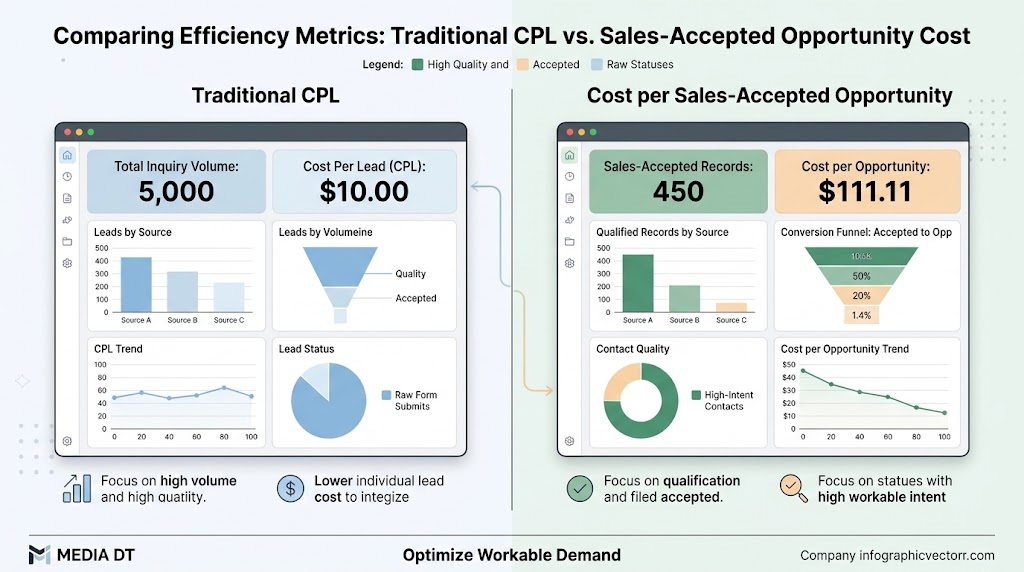
CPL is only meaningful when the paid event is fixed. A form submit, a qualified call, and a booked appointment are different products. If the definition drifts while you “optimize CPL,” you are comparing different goods.
Write the paid unit in one line. Align it with what sales counts as workable. Then measure three numbers on the same period:
- Cost per inquiry (classic CPL).
- Cost per sales-accepted record.
- Cost per opportunity or sale.
If CPL falls while cost per opportunity rises, you did not reduce cost. You shifted waste into the sales queue. Google Ads defines average CPA as conversion cost divided by conversions for the same scope. Treat platform CPA the same way: same event, same window, same filters. See Google’s definition of average CPA for the measurement principle—not as a substitute for your sales-accepted bar.
Cut Waste Before You Cut Bids
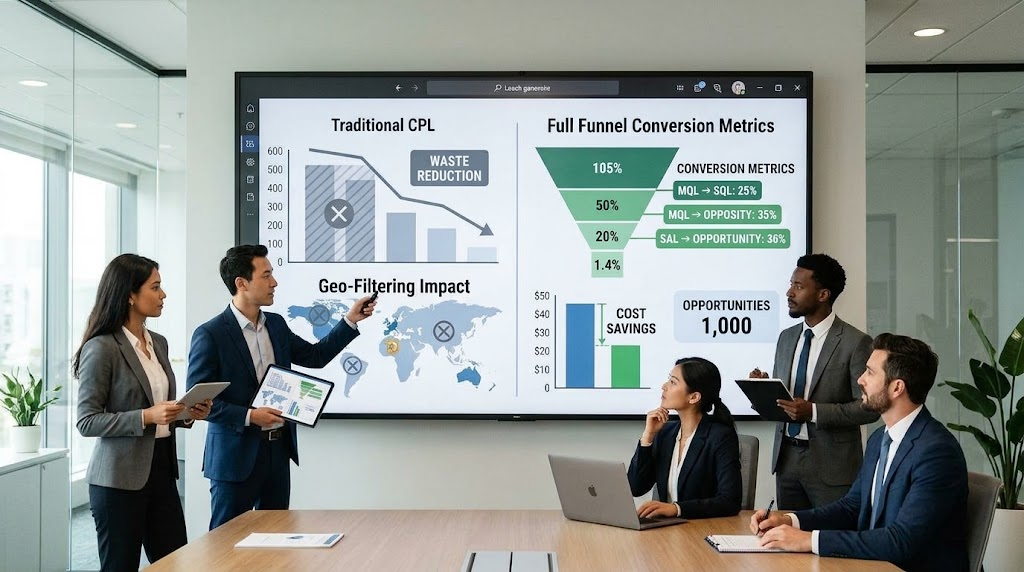
Most CPL problems are waste problems. Fix these before you demand a lower headline rate from every source.
1. Geo and eligibility waste
Exclude locations, job types, or company sizes you cannot serve. Every out-of-area inquiry inflates volume and CPL optics while destroying acceptance.
2. Query and audience waste
Negatives, intent filters, and placement exclusions remove clicks that never had a path to sales-ready. Cheaper clicks with zero acceptance are not efficiency.
3. Duplicate and shared-inventory waste
Paying repeatedly for the same person, or buying heavily shared records that five teams dial at once, raises true cost even when the invoice CPL looks low. Exclusive and shared inventory behave differently on contact rates. For the trade-offs, see exclusive leads vs shared leads.
4. Speed waste
Slow first touch turns good inquiries into dead ones. That shows up as “bad quality” in reports when the real failure is response time. Fix SLA and routing before you replace the source.
Levers That Lower Cost Without Trashing Quality
Tighten match to high intent
Higher intent usually means fewer inquiries and better acceptance. Cost per accepted record often falls even when headline CPL rises slightly. For what high-intent demand looks like in practice, see high-intent leads and why they convert. Use that lens to drop low-intent paths instead of averaging them into a cheaper blended CPL.
Improve conversion on traffic you already buy
Landing clarity, form length, call routing, and offer honesty change cost without changing the media partner. A higher conversion rate on the same clicks lowers CPL and often improves quality if messaging stays accurate.
Cap and schedule volume to sales capacity
Buying more than the team can work on time creates false quality failures. Cap daily volume to capacity. Off-hours volume needs an owner or it should not be purchased.
Renegotiate the event, not only the price
A slightly higher CPL on a stricter qualified event can beat a cheap CPL on raw submits. Negotiate fields, filters, and credit rules—not only the dollar figure on a vague “lead.”
Kill sources by accepted-cost, not by story
Rank sources by cost per sales-accepted record over a fixed window. Pause the bottom tier. Do not keep a source because it “used to work” in a different season or with a different sales team.
Worked Example: Same Budget, Better Unit Cost
Suppose two sources each spend the same media budget in one week. Source A delivers a lower CPL but a weak sales-accepted rate. Source B costs more per inquiry and clears acceptance far more often. On cost per sales-accepted record, Source B wins. Keeping Source A because the dashboard CPL looks cheaper is how teams save money into a stalled pipeline.
Run that comparison on your real dispositions before you renew the cheap source.
Numbers to put in one sheet
- Spend.
- Inquiries.
- Sales-accepted count.
- Opportunities.
- CPL, cost per accepted, cost per opportunity.
If you cannot fill the sheet, you are not ready to claim an efficiency win.
What Not to Do When You Chase a Lower CPL
- Do not strip required fields so more forms complete. You will pay less per submit and more per hour of sales research.
- Do not move to the cheapest shared pool without measuring contact rate.
- Do not change the paid event mid-test and still call it the same CPL trend.
- Do not cut compliance or consent steps to save media cost. Legal and brand cost arrive later.
- Do not optimize only inside the ad platform if sales dispositions never flow back.
These shortcuts create a temporary CPL win and a durable pipeline loss.
Partner Conversation When You Want a Better Rate
When you ask for a lower rate, also ask for a clearer event. A useful line is: “Price is open for discussion if delivery includes geo, offer interest, and credit on invalid contacts. Vendors will be scored on cost per sales-accepted record, not CPL alone.”
Partners who only defend headline CPL without field or credit flexibility are optimizing their invoice, not your accepted cost. Bring last month’s reject codes to the call. Specific codes turn a price argument into an operational fix.
Landing and offer checks that protect quality
Before you scale a cheaper path, confirm the landing page promise matches what sales is allowed to sell. Mismatch creates refunds and “bad lead” tags that look like a source problem. Short forms can lower CPL. They also raise unqualified volume if you remove the fields sales needs. Keep the minimum fields that support acceptance decisions.
If you run call-based demand, confirm hours of operation and overflow rules. Cheap call volume outside staffing windows is wasted spend with a clean-looking media report.
A Simple Weekly Efficiency Review
Run one short review every week:
- CPL by source.
- Sales-accepted rate by source.
- Top three reject reasons.
- Median time to first attempt.
- Cost per sales-accepted record.
Act on one change only: a geo cut, a creative pause, a partner filter, or an SLA fix. Multiple changes in the same week hide what worked.
Where Media DT Fits
Media DT builds high-intent lead generation and inbound call programs for teams that care about accepted demand, not only inquiry charts. Efficiency comes from better match and cleaner delivery—not from flooding the CRM at the lowest possible CPL.
That approach fits buyers who will maintain a sales-ready bar and review dispositions. It is a poor fit if the only KPI is the cheapest possible form at maximum volume.
Checklist: Lower Cost, Keep Quality
- Paid event and sales-accepted definition are written and stable.
- Waste filters (geo, query, eligibility) are on before rate negotiations.
- Volume matches sales capacity and SLA.
- Sources ranked by cost per sales-accepted record.
- One efficiency change per week, measured on accepted outcomes.
Reduce cost per lead only when the unit still deserves a sales hour. Anything else is a discount on noise.
Work the Unit Economics, Not the Vanity CPL
Quality-safe efficiency is a system: clear unit, less waste, intent match, capacity discipline, and accepted-cost reporting.
Explore high-intent lead and inbound programs with Media DT.
Is a lower CPL always better?
No. If sales-accepted rate falls faster than CPL, cost per workable opportunity goes up. Optimize the unit sales will work.
What should I cut before asking for a lower rate?
Out-of-area traffic, low-intent queries, duplicates, and slow follow-up. Waste removal often beats a pure price cut.
Which metric should sit next to CPL?
Cost per sales-accepted record and cost per opportunity, on the same time window and source filters.
When is a higher CPL acceptable?
When the paid event is stricter and cost per accepted opportunity still improves.
How does Media DT approach efficiency?
Through high-intent match and cleaner delivery, not by maximizing the cheapest possible inquiry volume.
Want efficiency without flooding sales?
Media DT delivers high-intent lead generation and inbound call programs measured on demand sales can work—not vanity CPL alone.
Explore high-intent programs with Media DT