
- Call routing sends each inbound call to the right person, queue, or after-hours path—before the homeowner hangs up.
- Route by job type, location, and urgency—not by whoever happens to pick up.
- Missed and misrouted calls destroy paid call ROI faster than most media problems.
- Track answer rate, time-to-answer, transfers, and booked jobs by route.
- Media DT inbound programs work best when routing can actually receive and qualify the call.
Call routing is how inbound phone demand reaches someone who can help. For home-service teams, a wrong queue or a dead after-hours path turns expensive HVAC, plumbing, and electrical inquiries into voicemail graveyards.
This guide covers practical routing patterns for inbound home-service phones: what to separate, how to handle overflow, what to measure, and how routing ties to paid calls and tracked numbers.
What Call Routing Must Solve for Home Services
Homeowners call with urgency. They need:
- A human or clear next step quickly.
- Someone who covers their area.
- Someone who handles that job type (repair vs install vs emergency).
- A path when the primary line is busy or closed.
If routing cannot do those four things, media spend only increases frustration.
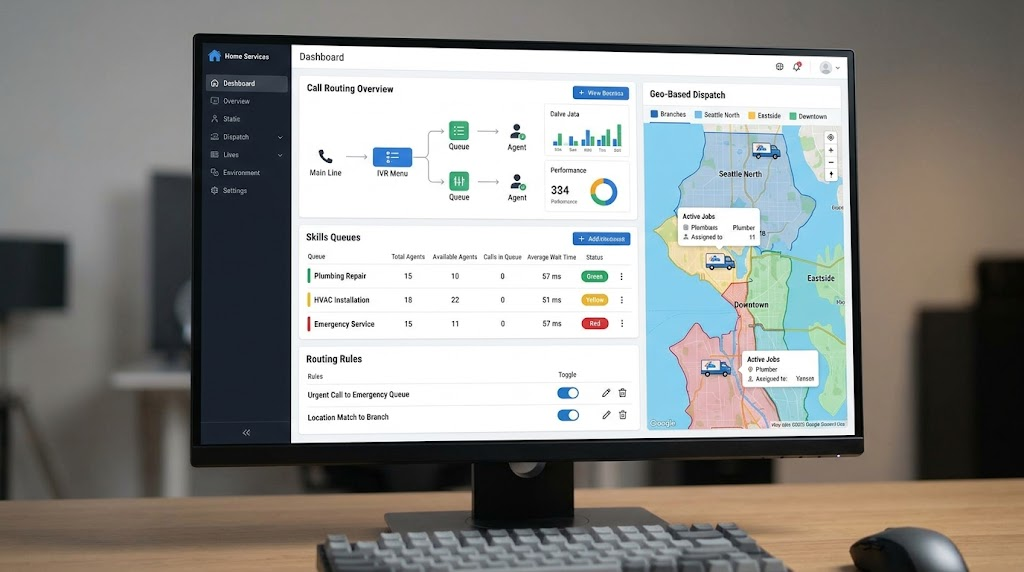
Core Routing Patterns That Work
| Pattern | Use when | Watch out |
| Skills / job-type queues | Repair vs install vs sales differ | Too many menus; callers hang up |
| Geo-based routing | Multi-branch or large territory | Stale zip lists; wrong branch |
| Time-of-day / after-hours | Emergency trades, long hours | Voicemail with no callback SLA |
| Overflow / hunt groups | Spikes and short staff | Endless rings; no owner |
| Source-based numbers | Paid search, LSA, partners differ | Untracked shared lines |
Start simple: one emergency path, one standard service path, one after-hours owner. Add menus only when volume justifies them.
Build the Path Before You Buy More Calls
Map who answers what
List open hours, on-call rotation, branches, and job types each group can book. Routing rules are only as good as this map.
Define the paid event
If you buy pay-per-call demand, align routing with what counts as a qualified connected call—duration, answer, job match—not just a ring. For how payable call products are usually defined, see what pay per call leads are.
Keep menus short
Every extra IVR layer loses impatient callers. Prefer two clear choices over five. Offer a zero-out to a human whenever you can staff it.
Tracking and Attribution Belong in the Route
Use unique numbers or dynamic numbers by channel so marketing can see which paths book jobs. Operational detail on numbers, sessions, and lead programs is covered in how call tracking works in lead generation. For advertising-platform call conversion options, Google’s documentation on phone call conversions explains how clicks-to-call and call reporting can be measured in Google Ads. Platform metrics still need your CRM or dispatch outcome attached.
Route labels should survive into reporting: source, queue, answered by, disposition, booked yes/no.
After-Hours and Overflow: Where ROI Dies Quietly
Most “bad lead” complaints after paid spikes are unanswered or late-returned calls.
- Name an after-hours owner or answering service with a written callback SLA.
- Cap concurrent rings so calls do not rotate into oblivion.
- Record voicemail only if someone clears it on a schedule.
- On peak weather days, prioritize emergency queues over sales-only lines.
If you cannot staff nights, stop buying night traffic. Routing cannot invent people.
Metrics for Inbound Routing
Review weekly:
- Answer rate by queue and by hour.
- Median time to answer.
- Transfer rate and drop rate after transfer.
- Booked jobs by route and by source.
- Abandon rate on IVR.
Improve the worst hour and the worst queue first. Average account stats hide the failure. Publish a simple wallboard or daily email: missed calls by hour, abandon rate, and bookings by queue. Visibility changes behavior faster than a quarterly vendor meeting.
When answer rate drops below your threshold for two days, pause the weakest paid source for that window instead of arguing about lead quality in the abstract. Test overflow by calling your own public numbers at open, lunch, and close. Mystery calls catch broken hunt groups before customers do.
A Practical Rollout Sequence
- Week 1: Document hours, skills, geos; pick primary and overflow humans.
- Week 2: Implement simple routes; label numbers by source.
- Week 3: Measure answer and book rates; fix the worst slot.
- Week 4: Add one advanced rule (geo or job type) only if volume supports it.
Change one major routing rule at a time so you can see what improved.
Multi-location and multi-trade realities
When branches share a brand number, geo routing must stay current. A closed territory still in the route creates apologetic transfers and lost trust.
Multi-trade shops (HVAC plus plumbing, for example) should separate emergency skills early. A plumber answering a no-cool call only to transfer twice teaches callers to dial a competitor. Franchise or dealer networks need clear rules for who owns the first answer versus who owns the job. Ambiguity shows up as double callbacks and double no-shows.
CSR coaching that supports routing
Train the first line to confirm zip and job type in under a minute, then stay on the path or warm-transfer with context. Cold transfers without notes waste both sides. Give CSRs a one-screen cheat sheet: which queue handles what, who is on call, and what not to promise on timing.
Listen to a sample of abandoned IVR attempts monthly. If callers repeatedly mash zero, shorten the tree.

Buying inbound calls without routing readiness
Partners can deliver qualified callers and still look “low quality” if your team misroutes or misses them. Fix answer paths before disputing every campaign. Share your hours, overflow rules, and disposition codes with any call seller so volume matches when you can actually talk.
Where Media DT Fits
Media DT generates high-intent inbound calls and leads for performance buyers in home services and related verticals. Those calls only convert if your routing answers, qualifies, and books.
Strong fit when queues, hours, and dispositions are real. Weak fit when every number rings a shared desk with no ownership.
Call Routing Checklist
- Job-type and geo map written down.
- After-hours owner and SLA named.
- Overflow path tested.
- Source numbers tracked.
- Answer and book rates reviewed weekly.
Routing is operations infrastructure. Treat it that way before you scale paid calls.
Simple example schedules
Weekday 7 a.m.–6 p.m.: live CSR queue by job type. 6 p.m.–10 p.m.: on-call tech for emergencies only; sales callbacks next morning. Overnight: answering service with priority tags for no-heat / no-cool / active leak. Saturday: shorter live window, higher overflow to on-call. Sunday: emergency-only if that matches how you actually staff.
Write the schedule into the phone system and the employee handbook. Informal “someone usually picks up” is not a route. Rehearse holiday weeks the same way you rehearse peak weather. Paid campaigns rarely pause just because your office party does.
Route the Call, Then Scale the Media
Get the path right—right person, right hours, tracked outcome—then buy more inbound demand. That order—path first, volume second—is what separates profitable call routing from expensive ring noise. Keep that sequence every time weather or marketing spikes hit the board—no exceptions for “just this week.”
That discipline is the whole advantage of professional call routing for home-service teams. Explore high-intent lead and inbound programs with Media DT.
Bring your routing map and answer-rate by hour so inbound volume is aimed at times and queues that can actually convert.
When media, phone systems, and dispatch share one answer-rate scoreboard, inbound call programs stop being a blame game and start being a controllable channel.
What is call routing for home services?
Rules that send each inbound call to the right queue, branch, or after-hours owner by job type, geo, and time—so paid demand reaches someone who can book.
Should every trade share one menu?
Only at low volume. As soon as repair vs install or multi-trade volume grows, separate skills or you train callers to hang up.
What kills ROI after hours?
Voicemail with no callback SLA, or overflow that rings nobody. Name an owner or pause night traffic.
Which metrics matter weekly?
Answer rate by hour and queue, time-to-answer, abandon rate, and booked jobs by route and source.
How does Media DT relate?
High-intent inbound calls convert only when your routing answers and qualifies; fix the path before scaling volume.
Ready for inbound calls your team can answer?
Media DT delivers high-intent leads and inbound calls for home-service teams that staff real routing—so volume hits queues that book, not voicemail.
Explore high-intent programs with Media DT