
Key Takeaways
- Can the vendor show exact consent language and timestamp records for sample leads?
- Is the lead exclusive to you, or shared with a defined number of other buyers?
- What filters are applied before delivery (geography, product type, age band, homeowner status)?
- What is the real contact rate and quote rate in the first 7–14 days, not the promised CPL?
- How are returns, invalids, and disputes handled in writing?
- Does call tracking or CRM integration exist so you can attribute outcomes by source?
Insurance agencies do not fail because they lack product knowledge. They fail when the pipeline is full of contacts who never answer, never quote, and never buy. Effective lead generation for insurance is not about buying the cheapest names on a list. It is about matching intent, compliance, and sales capacity so every dollar of acquisition spend has a realistic path to a policy.
Insurance is a high-consideration purchase. Consumers research online, compare options, and often expect a phone conversation before they commit. That makes phone-capable, high-intent programs especially valuable—and it also makes bad lead sources expensive. Shared, poorly consented, or poorly filtered volume burns agent time and inflates cost per issued policy.
This practical guide covers how insurance lead generation works in the field, which channels tend to produce usable conversations, why exclusivity and compliance matter, and how to measure success beyond cost per lead. The focus is operational: what agencies and buyers should demand so growth does not collapse under low contact rates and compliance risk.
What Lead Generation for Insurance Really Requires
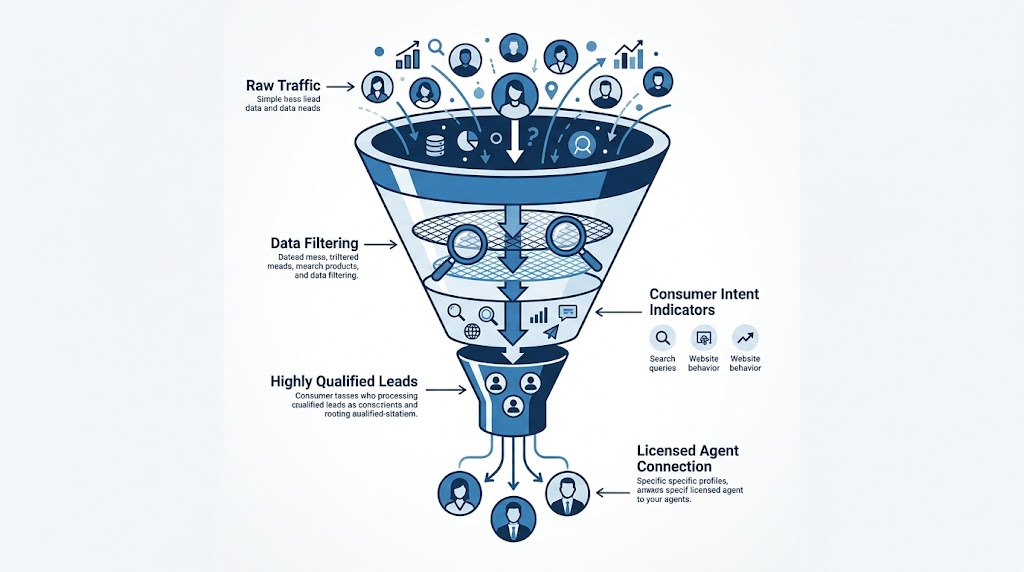
At a practical level, lead generation for insurance means identifying people who have a near-term need for coverage—auto, home, life, health, Medicare, or commercial—and connecting them with a licensed agent who can quote and close. The “lead” is not the form submission alone. It is a contact opportunity with enough intent and data for a productive first conversation.
Insurance verticals differ in cycle length and regulation. Auto and home often move faster when a quote is requested. Life and Medicare may require more education and multiple touches. Across all of them, speed-to-contact, clear consent, and accurate qualification questions determine whether the opportunity survives the first call.
Agencies that treat all “insurance leads” as interchangeable usually discover the hard way that source, exclusivity, and consent quality change conversion by multiples. The same budget can produce pipeline or produce noise depending on those variables.
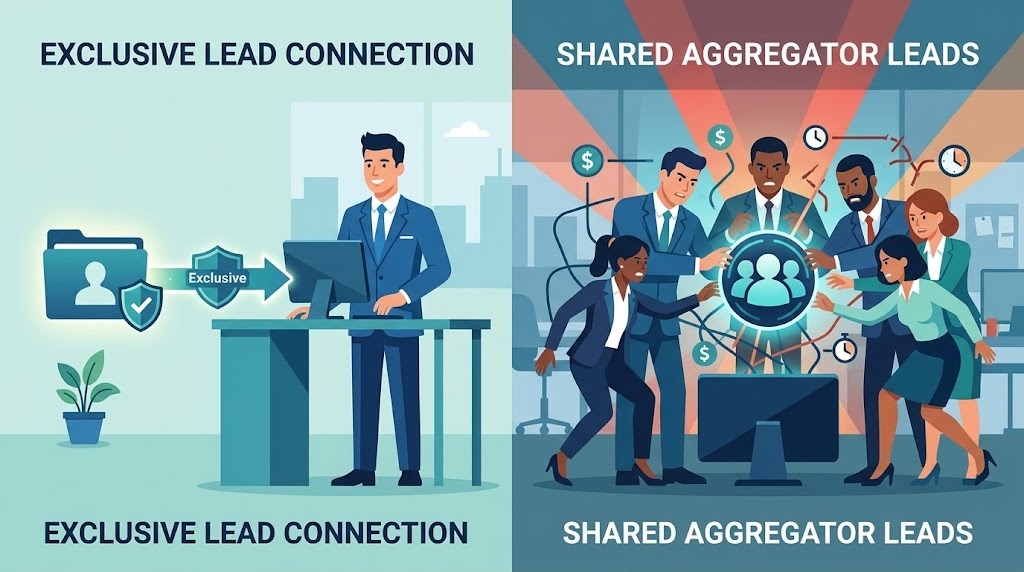
If you are still clarifying foundational definitions of what counts as a marketing lead versus a sales-ready opportunity, start from first principles and then map them onto insurance-specific qualification. The mechanics of exclusive versus shared delivery also matter heavily in this vertical, because multiple agents calling the same consumer within minutes destroys both conversion and brand experience.
Channels That Commonly Work for Insurance Leads
No single channel owns insurance acquisition. Strong programs mix sources and judge each one on cost per issued policy, not vanity CPL.
Paid Search and High-Intent Landing Pages
Search captures active demand: people typing quote-related queries are often closer to a decision. Landing pages that ask the right filters—ZIP, vehicle or property details, coverage need, contact preference—improve downstream close rates. The tradeoff is higher cost per click in competitive markets. Tracking which keywords produce calls and quotes, not only form fills, is essential.
Pay-Per-Call and Live Transfers
When a consumer is ready to talk, a live transfer or inbound call can outperform a form that sits in a queue. Pay-per-call models charge for connected conversations, which aligns cost with contact opportunity. Quality still depends on how traffic is sourced, how consent is collected, and how quickly the receiving agent answers. For a deeper look at how that model works, see our guide on what pay-per-call leads are and how they fit high-intent programs.
Exclusive Digital Leads vs Shared Aggregator Leads
Exclusive leads go to one buyer. Shared leads go to several at once. In insurance, competition for the same consumer compresses contact windows and often lowers close rates. Exclusive inventory usually costs more per lead but can deliver a lower cost per policy when agents can follow a disciplined process without racing three other offices. We break down the operational differences in detail in exclusive leads vs shared leads—the same logic applies strongly to insurance quote traffic.
Compliance Is Not Optional in Insurance Lead Generation
Insurance outreach often involves phone and text. That brings TCPA, state mini-TCPA rules, Do Not Call obligations, and consent documentation into the center of the operation. Buying a list does not transfer legal risk away from the calling party.
Prior express written consent standards, clear disclosures, and recoverable records of what the consumer agreed to are baseline requirements for marketing calls that use autodialers or prerecorded messages. Even when consent frameworks evolve through court or FCC actions, the operational habit of clean capture and retention remains the safest posture.
Agencies should require vendors to show sample consent language, seller identification practices, and audit access—not just marketing claims that leads are “compliant.” For consumer-facing insurance education and industry context, the
National Association of Insurance Commissioners (NAIC) remains a primary official reference point for how the industry is organized and how consumer protections are framed across states.
Pair that regulatory awareness with internal process: suppression lists, opt-out handling, call recording policies, and duration of consent record retention. Compliance failures are expensive; so is rebuilding trust after a wave of complaints.
How to Evaluate Insurance Lead Sources
Use a short scorecard before you scale any source.
Cheap shared leads with weak filters often look efficient on a spreadsheet until agent hours and close rates are included. Expensive exclusive leads can look expensive until cost per issued policy is calculated. Always finish the math.
For broader pipeline design and lead handling discipline outside pure insurance tactics, practical frameworks such as HubSpot’s lead generation guide help teams keep stages and definitions consistent—then overlay insurance-specific compliance and product filters.
Operational Habits That Improve Close Rates
Source quality is only half the equation. How the agency works the lead determines whether good volume becomes policies.
Speed and Cadence
Insurance consumers who request a quote often receive multiple contacts. The first clear, professional response has an advantage. Define SLAs for first dial or first live answer, then build a multi-touch cadence that mixes call, text (where consented), and email without becoming spam.
Qualification Before Pitch
Agents who immediately pitch product without confirming need, timeline, and decision process waste time. Short qualification scripts improve both conversion and customer experience. Capture the answers in the CRM so the next touch continues the conversation instead of restarting it.
Feedback Loops to Media
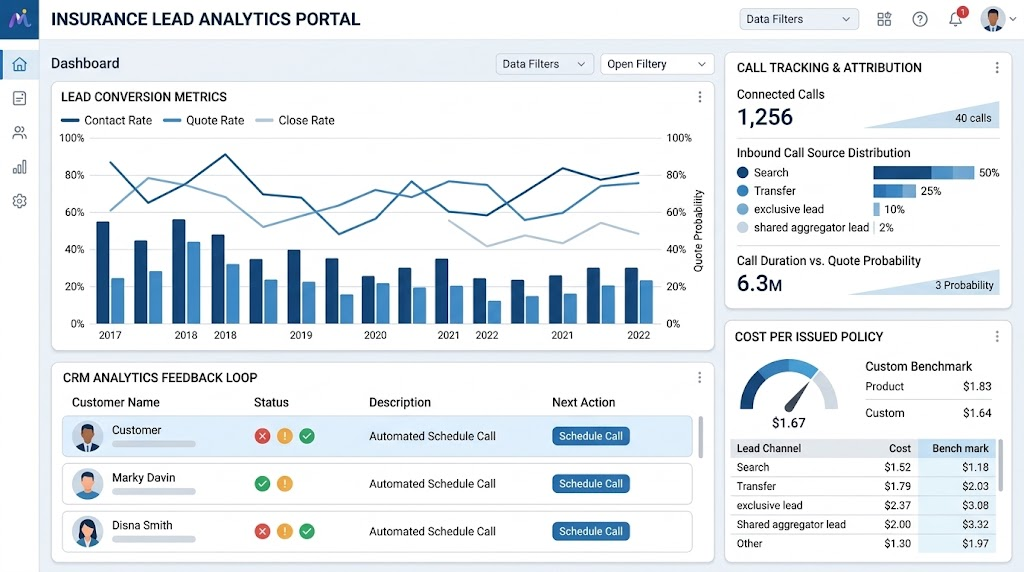
Weekly reviews of contact rate, quote rate, and issued policy by source close the loop. Sources that look cheap but never issue should be cut. Sources that cost more but produce stable issue rates deserve more budget. Without that feedback, media and sales operate on different scoreboards.
Building a Sustainable Insurance Lead Mix
Mature agencies rarely rely on one channel. A durable mix often includes:
- A core of exclusive, high-intent digital or pay-per-call volume for predictable pipeline
- Referral and partner programs for high-trust opportunities
- Selective paid search on proven keywords with strong landing pages
- Careful testing of new sources at low volume before scale
The goal is not maximum lead count. The goal is a repeatable cost per issued policy that supports growth and agent capacity. When capacity is constrained, exclusivity and quality matter more than filling the dialer.
Document definitions of valid lead, qualified lead, and issued policy so every vendor conversation uses the same language. Ambiguity in definitions is how budget leaks into disputes instead of policies.
Insurance lead generation also benefits from clearer product segmentation. Auto, home, life, and Medicare prospects respond to different messaging and different urgency. Treating every inquiry as a generic “insurance lead” forces agents to rediscover basic context on every call. Capture product type, timeline, and decision role at the form or call open so the conversation starts further down the path.
Geography still matters more than many national campaigns admit. Licensing, carrier appetite, and competitive density vary by state and metro. Sources that cannot filter cleanly by location waste both media spend and agent time. Require ZIP or state-level precision in delivery rules and reject volume that cannot meet those filters consistently.
When you test a new vendor, run a controlled pilot with fixed volume, fixed SLAs, and a pre-agreed definition of valid and qualified. Two weeks of disciplined testing with full CRM tagging usually reveals more than months of mixed, untracked buying. Scale only after contact and quote rates clear your internal thresholds.
Finally, protect the agent experience. High-volume shared leads with low answer rates train agents to treat every new record as low priority. That cultural slide is hard to reverse. Prefer sources that respect exclusivity and consent so agents stay motivated to work every opportunity with full effort.
Another practical layer is creative and offer testing. Insurance consumers respond differently to rate-focused messaging versus coverage-gap messaging versus life-event messaging (new car, new home, new baby, aging into Medicare). Landing pages and call scripts should reflect the traffic source intent. A generic “get a free quote” page for every keyword usually underperforms pages that mirror the query and set clear next steps.
Attribution discipline closes the loop. If your team cannot see which source produced the issued policy—not just the lead—budget decisions remain guesswork. Connect call tracking, form source fields, and CRM opportunity stages so media and sales share one truth. Without that chain, cheap leads keep winning the argument even when they lose the P&L.
Vendor contracts should spell out invalid definitions, return windows, exclusivity guarantees, and audit rights in plain language. Ambiguous terms create recurring disputes that consume management time. Prefer partners who can show historical quality metrics and who accept accountability when delivery drifts from the agreed standard.
Seasonality and regulatory change also affect insurance lead generation. Rate environments, carrier appetite, and state rule updates can shift conversion overnight. Build quarterly review points into your media plan so you are not locked into last year’s mix when conditions move.
Training is the final multiplier. Even excellent exclusive leads fail when new agents lack scripts, product knowledge, or objection handling. Pair acquisition investment with coaching and call review. The agencies that compound results treat lead quality and agent skill as one system, not two separate problems.
Start with the constraints you actually have—agent headcount, licensing footprint, carrier panel, and average premium—and design acquisition around those limits. Then demand sources that respect the same constraints. That is how insurance agencies build pipeline that scales without burning people or budget.
Put simply: lead generation for insurance is a system. Traffic quality, consent integrity, exclusivity, speed-to-contact, agent skill, and post-sale measurement all have to move together. Fixing only one piece while ignoring the others produces temporary gains that fade as volume increases.
When those pieces are aligned, insurance lead generation stops feeling like a lottery and starts behaving like a managed growth channel—one you can forecast, improve, and defend in every budget meeting.
Ready for Insurance Leads That Agents Can Work?
Insurance growth depends on conversations that turn into quotes and policies. High-intent, TCPA-aware delivery designed for real sales capacity is how you stop paying for noise.
Ready for high-intent leads that sales actually wants?