
Key Takeaways
- TCPA compliant lead delivery treats consent and documentation as product features—not paperwork after the fact.
- Prior express written consent, clear disclosures, and recoverable audit trails reduce the risk of costly disputes.
- Active opt-in (no pre-checked boxes) and forensic consent tools support stronger proof when challenges arise.
- Buyers should verify current FCC requirements with counsel; rules and case law evolve.
- Partnering for compliance lets sales teams scale contact activity with clearer process and brand protection.
One compliance failure can cost more than a year of media budget. That is why TCPA compliant lead delivery is not a legal footnote for US lead generation—it is an operating standard. The Telephone Consumer Protection Act (TCPA) sits at the center of how marketing calls and texts may be made, and buyers who treat it casually inherit risk they often cannot see until a demand letter arrives.
At Media DT (mydt.com), we treat TCPA compliance as a competitive advantage, not a hurdle. Programs that capture clear consent, retain proof, and deliver only contacts that meet campaign rules protect both conversion rates and brand reputation. Programs that skip those steps may look cheaper on a rate card and far more expensive in total cost of ownership.
This article explains the risks of weak compliance, what a practical compliance framework includes, how consent documentation supports long-term trust, and how buyers should evaluate TCPA compliant lead delivery partners. It is written for operators who need actionable process—not legal advice. Always confirm current requirements with qualified counsel, because statutes, FCC rules, and court decisions change.
Understanding the Risks of Non-Compliance
The TCPA is among the most consequential regulations for any US-based lead generation or outbound contact program. Statutory damages, class exposure, and reputational harm can dwarf the savings from buying the cheapest available contacts. One process mistake—unclear consent, missing records, or calling practices that do not match the consent obtained—can escalate quickly.
Risk is not only “illegal robocalls.” It includes gaps between what the consumer agreed to, what the lead buyer believes they received, and what the calling team actually does. When those three layers diverge, defense becomes difficult even when intent was good.
Media buyers also face secondary risk: platforms, carriers, and partners increasingly expect cleaner consent practices. Weak documentation can limit which channels you can use and which buyers will accept your volume. Compliance quality affects commercial access, not only courtroom outcomes.
For foundational concepts and how compliant generation is structured in performance programs, see our related overview of
TCPA compliant lead generation. This article focuses on delivery standards and the operational habits that make “compliant” more than a marketing adjective.
What TCPA Compliant Lead Delivery Requires in Practice
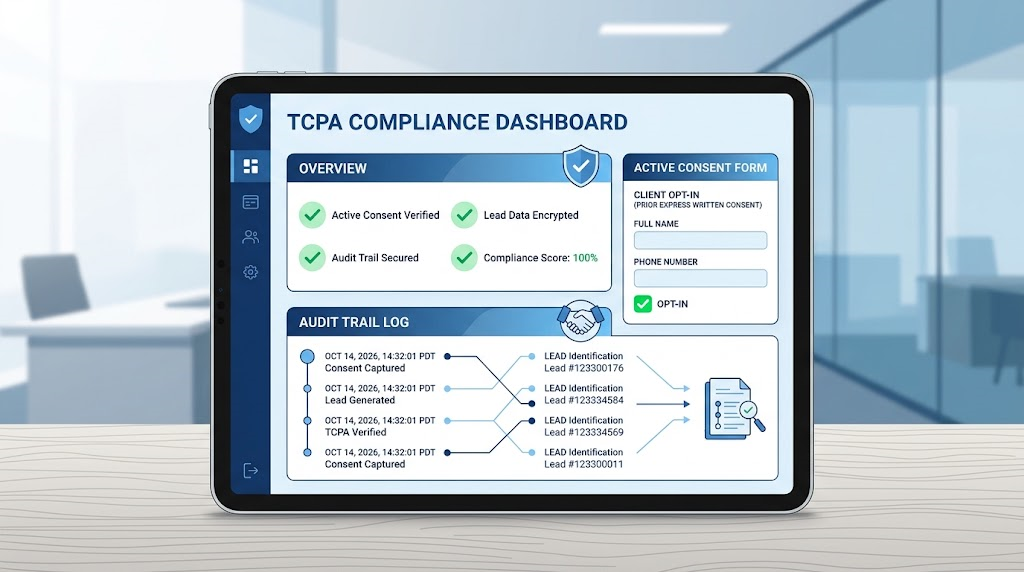
Labels do not equal process. A useful compliance framework ties capture, storage, and delivery into one chain that can be audited.
Prior Express Written Consent as a Design Requirement
Where TCPA rules require prior express written consent for certain autodialed or prerecorded telemarketing calls and texts, the consent mechanism must be clear, affirmative, and properly scoped. Passive or ambiguous acceptance is a common failure point. Active opt-in—where the consumer takes a clear step to agree—supports stronger process integrity than pre-checked boxes.
Consent language should disclose material terms in a way consumers can understand. The lead system should record what was shown, what was agreed, when it was agreed, and which phone number was authorized. Without that chain, “we had consent” becomes a claim instead of evidence.
Forensic Documentation and Audit Trails
Modern programs often use consent-recording tools that capture a visual or data playback of the consumer’s path—form fields, disclosures, timestamps, and identifiers. Services in this category (commonly discussed in the industry include tools such as Jornaya and TrustedForm/LeadiD-style certificates) help create a recoverable record. The point is not the brand name of the tool; the point is whether you can produce proof that matches the contact event if challenged.
Documentation must be retained long enough to cover realistic dispute windows and accessible to the parties who need it—compliance, legal, and operations—not locked in a vendor portal nobody monitors.
Delivery Rules That Match Consent
TCPA compliant lead delivery means the contact you receive is one you are prepared to handle under the consent that was collected. If consent was limited by seller, topic, or channel, downstream calling practices should respect those limits. Delivery systems that ignore that alignment create risk for the buyer even when the publisher’s form looked clean.
FCC materials on prior express written consent and related telemarketing rules provide official context for how regulators frame these obligations. See, for example, the Commission’s
FAQs on the one-to-one consent rule for TCPA prior express written consent. Rule details and effective dates have been subject to further process and litigation; treat official pages and counsel guidance as the source of truth for current obligations, not blog summaries.
Our Compliance Framework at Media DT
We design programs so that leads delivered through our TCPA-oriented workflows are backed by active consent capture and documentation practices appropriate to the campaign.
- Active consent: We do not rely on pre-checked boxes. Users must take an affirmative step to opt in.
- Forensic documentation: Where applicable, we support audit-oriented consent records so there is a recoverable trail of what the user saw and agreed to.
- Verified delivery discipline: Campaign rules, filters, and handoff processes are meant to reduce the chance that buyers receive contacts they cannot defensibly work under the consent collected.
No provider can eliminate all legal risk. What a serious partner can do is refuse shortcuts that make risk invisible—unclear disclosures, missing timestamps, or delivery that does not match the consent path.
Exclusivity and quality still interact with compliance. A clean consent record on a shared lead that five other teams also call does not solve operational chaos. Pair compliance with delivery models that your sales process can actually support—see
exclusive leads vs shared leads for how exclusivity changes the working window after a compliant contact arrives.
Building Long-Term Trust with Compliant Delivery
By partnering with a team that treats compliance as infrastructure, you protect more than a single campaign. You protect the brand’s ability to keep contacting customers, keep working with serious publishers, and keep sales focused on conversations instead of fire drills.
Trust compounds. Buyers who can show auditors and partners a consistent consent story scale more calmly. Buyers who discover gaps only after a complaint spend management time on defense instead of growth.
Compliance also supports better media decisions. When consent and documentation are solid, you can invest in higher-intent channels—including phone-based programs—with clearer eyes. For how voice fits performance acquisition, see
what pay-per-call leads are. Call programs still need consent and process discipline wherever TCPA-covered practices apply.
Consumers and regulators continue to focus on unwanted calls and texts. The FCC’s consumer-facing guidance on stopping unwanted robocalls and texts reflects that priority. Operators who align with cleaner consent norms are better positioned as expectations rise.
How Buyers Should Evaluate TCPA Compliant Lead Delivery
Use concrete questions—not slogans—when you assess a partner.
- Can they show sample consent language and the exact consumer path for a recent campaign?
- Is opt-in active (no pre-checked boxes) for the programs you will buy?
- What consent-recording or certificate tools are used, and how long are records retained?
- Who can access audit records, and how fast during a dispute?
- How do delivery filters enforce campaign scope (seller, topic, geo, channel)?
- What happens when a contact is challenged—process, timelines, and responsibilities?
Require answers in writing. Verbal assurances fade; process documents and sample packets do not. Run a pilot with full documentation review before you scale volume.
Also separate compliance claims from lead quality claims. A contact can be documented and still be a poor fit for your product. Demand both: consent integrity and commercial match. High-intent filters, exclusive handling, and speed-to-contact still decide whether compliant leads become revenue.
Operational Habits That Keep Compliance Alive

Frameworks fail when daily habits drift.
Train the People Who Dial
Consent at capture does not automatically authorize every downstream script. Agents need clear rules on what was agreed, how to identify themselves, and how to honor opt-outs. Training is part of the compliance system.
Monitor Suppression and Opt-Outs
Honor requests quickly and keep suppression lists synchronized across vendors and internal tools. Lag here creates avoidable exposure.
Review Rules on a Schedule
FCC actions, court decisions, and state mini-TCPA rules change the landscape. Schedule periodic reviews with counsel and update vendor requirements accordingly. Static playbooks age badly in this domain.
Document exceptions. If a campaign uses a different consent path, write it down. Informal workarounds are how gaps appear under audit.
Finally, treat compliance reviews like creative reviews: scheduled, written, and tied to go/no-go decisions. A quarterly session with operations, media, and counsel beats an emergency scramble after a complaint. The gold standard is not perfection; it is a system that detects drift early and corrects it before scale multiplies the mistake.
Insurance, home services, and financial verticals attract extra scrutiny because contact volume is high and consumer complaints are visible. High-intent demand does not exempt you from process. It makes process more valuable—because the leads worth calling are also the ones worth documenting correctly.
State rules can add obligations on top of federal TCPA frameworks. Calling time windows, local registration, and mini-TCPA statutes may apply depending on where you dial and where the consumer lives. National programs need a state-awareness layer, not only a single federal checklist.
Technology is necessary but not sufficient. Consent certificates and playback tools fail if nobody reviews samples, if retention is too short, or if the calling team never sees campaign-level consent limits. Assign ownership: who checks a weekly sample of consent records, who updates suppression, and who escalates anomalies.
Vendor contracts should reflect the same standard. Spell out consent requirements, documentation access, invalid definitions, and responsibilities if a contact is challenged. Ambiguous contracts push risk onto the party least able to control upstream capture. Prefer partners who accept clear process language over those who only offer marketing claims.
TCPA compliant lead delivery also changes internal culture. When sales leaders know consent records exist and opt-out paths are real, they are less tempted to push gray-area volume just to hit weekly dial targets. Compliance becomes a shared operating constraint instead of a department that only appears when something breaks.
Start with the questions in the evaluation checklist, demand sample consent packets, and pilot before you commit major budget. The cheapest lead is never cheap if it arrives without a consent story you can stand behind.
That is the standard Media DT aims to support: active consent capture, recoverable documentation, delivery aligned to campaign scope, and partnerships that prefer transparent process over opaque volume. Scale is only useful when the foundation can hold the weight.
When those habits are in place, TCPA compliant lead delivery stops being a slogan on a website and starts functioning as risk infrastructure. Buyers gain clearer audit posture. Publishers gain clearer rules. Sales gains contacts that were designed to be contacted—not merely collected.
That is what gold-standard TCPA compliant lead delivery looks like in practice—disciplined, documented, and designed for teams that intend to be in market for the long run.
In short: protect the consent path, preserve the evidence, align delivery with what was agreed, and train everyone who touches the phone. Do that consistently, and compliance becomes a growth enabler instead of a recurring crisis.
Choose partners and processes that meet that bar—then scale with confidence.
Ready for Lead Delivery You Can Defend?
TCPA compliant lead delivery is the gold standard because it treats consent, documentation, and delivery alignment as core product—not optional extras. That standard protects brands, stabilizes partnerships, and lets sales teams focus on conversations that were meant to happen.
Ready for high-intent leads that sales actually wants—with process built for cleaner contact?