
In a hyper-competitive insurance market, volume without intent is expensive noise. High-intent lead generation is the opposite approach: fewer accidental clicks, more consumers who are already in a purchase-oriented phase of their journey—and who can actually be worked by a licensed agent.
At Media DT (mydt.com), success is not measured by the number of clicks that hit a landing page. It is measured by the quality of the conversation that follows. Spray-and-pray acquisition still exists, but it no longer supports stable cost per acquisition when agent time, compliance, and close rates are included in the math.
This article explains the shift to high-intent demand, how behavioral targeting and pre-qualification protect ROI, how to evaluate quality beyond lead volume, and how Media DT structures insurance programs so sales teams spend less time on wrong numbers and more time on real opportunities. The focus is operational—definitions, filters, and post-delivery outcomes—not slogans.
The Shift to High-Intent Lead Generation
Most providers still wrestle with cold contacts: people who clicked an ad by mistake, chased a reward, or never intended to speak with an agent. Those records inflate pipelines and demoralize sales. High-intent lead generation focuses on consumers who show active interest in a specific insurance need—auto, home, life, health, or Medicare—and who have taken a step that signals readiness to talk or quote.
Intent is not a vibe. It is inferred from behavior and confirmed through structured questions. Search queries that include quote, coverage, or product language carry different weight than generic brand discovery. Interactive funnels that ask for product type, location, and contact preference filter out traffic that cannot convert before it consumes agent hours.
The commercial implication is straightforward. When media is optimized for intent rather than raw form volume, contact rates and quote rates tend to improve even if absolute lead count falls. Agencies that only track cost per lead often miss this tradeoff until they calculate cost per issued policy.
For a wider practical playbook across channels, filters, and buyer evaluation criteria, see our
practical guide to lead generation for insurance. This piece focuses specifically on the high-intent strategy Media DT uses to keep quality in front of volume.
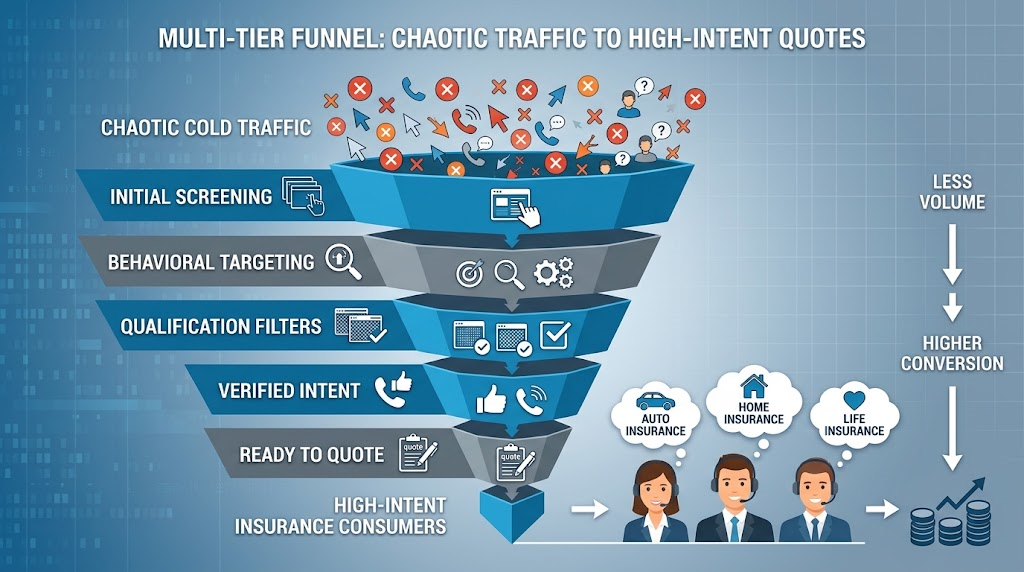
How High-Intent Targeting Works in Practice
Two layers do most of the work: identifying purchase-phase behavior, and pre-qualifying before delivery.
Behavioral Targeting
We analyze signals such as search queries and browsing patterns to identify users looking for specific insurance products—life, health, auto, and related lines. The goal is not to capture every visitor in a broad category. The goal is to prioritize people whose recent actions suggest they are comparing options or requesting a quote.
Behavioral targeting fails when it is treated as a black box. Buyers should still ask which verticals, geos, and traffic types are in play, and which signals are used only for optimization versus which are required for delivery eligibility.
Pre-Qualification Before the CRM
Interactive funnels ask the questions that determine fit: product interest, service area, and basic eligibility filters relevant to the campaign. Low-fit traffic is reduced before it reaches your CRM. That protects agent morale and keeps reporting closer to opportunities rather than raw inquiries.
Pre-qualification is only as strong as the questions and the honesty of the answers. Overly long forms can suppress conversion; overly thin forms pass noise downstream. The right balance depends on the product line and the buyer’s sales process.
Why Quality Matters for Insurance ROI
When you buy high-intent leads, your sales team spends less time handling wrong numbers and more time closing. That improvement in user acquisition efficiency is what lowers overall cost per acquisition and stabilizes growth.
Insurance is a conversation-heavy sale. A contact who never answers, who requested a product you do not write, or who is outside your licensed territory is not a cheap lead—it is a costly distraction. Quality is the mechanism that keeps media spend connected to issued policies instead of dialer activity.
ROI also depends on exclusivity and speed. Shared leads force multiple agencies to race the same consumer. Exclusive delivery gives your team a cleaner window to respond. The economics of that choice are covered in depth in our comparison of
exclusive leads vs shared leads. High intent without exclusive handling still leaks value when three other offices call first.
Compliance is part of quality, not a separate silo. Consent language, documentation, and calling practices protect both the brand and the economics of the program. For the regulatory layer that sits beside performance, review
TCPA compliant lead generation. High-intent traffic that arrives without clean consent is not a sustainable asset.
Evaluate Quality Beyond Lead Volume
Make the high-intent label useful by asking what the person requested and whether that request matches the product and service area you serve. Then compare results after delivery—rather than treating a form submission as a completed sale.
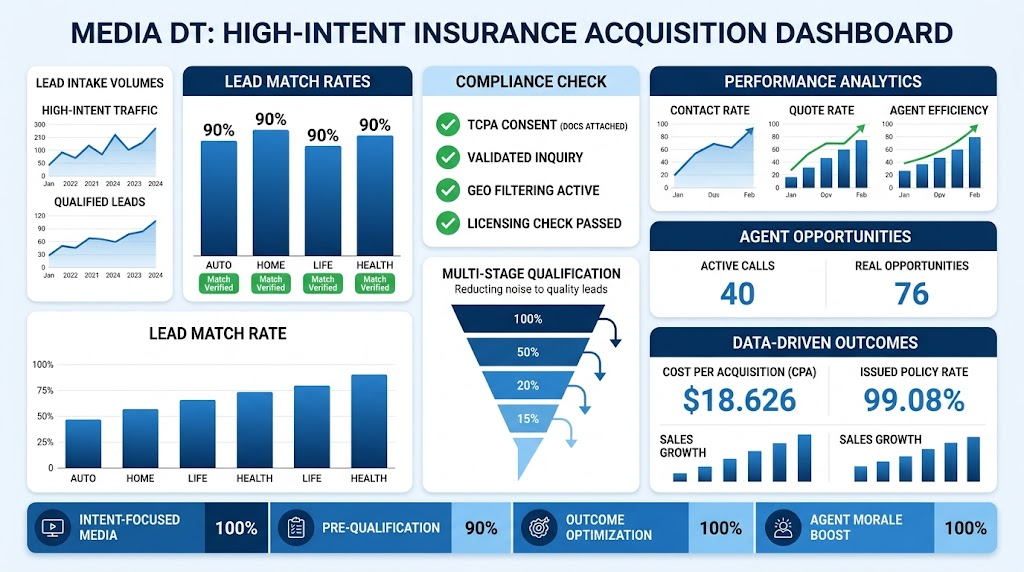
Match
Was the request relevant to the insurance product and location your team serves? A life insurance inquiry sent to an auto-only desk is not a quality problem in the abstract; it is a routing and filter problem. Track match rate by source.
Contact Outcome
Could the team reach the person, and did the conversation match the original request? Contact rate and conversation relevance are early indicators that the lead was real and correctly described.
Next Step
Did the conversation progress to a quote, appointment, or sale? Keep these outcomes separate and use a consistent denominator when comparing sources. Cost per lead, cost per contact, cost per quote, and cost per issued policy answer different questions.
A simple weekly scorecard keeps teams honest:
- Lead volume by source and product
- Match rate to product and geo
- Contact rate within the agreed SLA
- Quote or appointment rate
- Issued policy rate and cost per policy
Sources that win on volume but lose on issued policies should not keep budget by default. Sources that cost more per lead but win on cost per policy deserve expansion.
The Media DT Approach for Insurance Buyers
Media DT is built around high-intent acquisition for performance partners, with insurance as a core vertical. The operating principle is simple: filter for purchase-phase demand, deliver with clear definitions, and support the conversation quality that agents need.
- Intent-focused media: Prioritize traffic and creative aligned to specific product demand rather than generic “insurance” curiosity.
- Structured qualification: Use funnel questions and campaign rules to reduce obvious mismatches before delivery.
- Outcome-minded partnership: Treat post-delivery contact and quote feedback as part of optimization, not as optional commentary.
We do not claim that every lead becomes a policy. We claim that a high-intent system gives your team a fairer shot at productive conversations—and that measuring those conversations is how growth stays rational.
Industry context still matters. Consumer protection frameworks and market structure across states are shaped in part by organizations such as the National Association of Insurance Commissioners (NAIC). Performance teams that ignore the regulatory and consumer-trust environment eventually pay for it in compliance cost or reputation damage.
Operational Habits That Keep High-Intent Programs Healthy
Strategy fails in the details. These habits keep high-intent lead generation from drifting back into volume theater.
Align Capacity to Delivery
Do not buy more concurrent opportunities than agents can work within your SLA. Unworked high-intent leads become low-intent by the second day.
Feed Outcomes Back to Media
Weekly reviews of match, contact, and quote rates by source close the loop. Creative and targeting improve only when media sees what sales sees.
Protect Definitions
Do not silently widen “valid lead” criteria to hit volume goals. If the definition changes, document it and recalibrate historical comparisons.
For broader stage discipline across marketing and sales handoffs, practical frameworks such as HubSpot’s lead generation guide help teams keep language consistent—then overlay insurance-specific product, geo, and compliance filters.
Finally, protect agent experience. A steady stream of well-matched, reachable opportunities keeps teams engaged. A mixed stream of wrong-product and unreachable records trains agents to treat every new lead as low priority. High-intent strategy is as much about culture as it is about media—because culture decides whether the next call gets full effort.
Pilot design matters when you change vendors or funnels. Run a controlled test with fixed volume, fixed SLAs, and pre-agreed definitions of valid and matched leads. Two to four weeks of disciplined tagging in the CRM usually reveals more than months of mixed, untracked buying. Scale only after contact and quote rates clear your thresholds.
Geography and licensing constraints deserve explicit filters. National campaigns that ignore state licensing and carrier appetite create leads that look high-intent on paper and unworkable in practice. Require geo precision in delivery rules and reject volume that cannot meet those rules consistently.
Creative and landing experience remain part of intent. A high-intent query sent to a generic page that hides product details or asks for irrelevant fields will suppress conversion and create mismatched expectations on the call. Message match between ad, page, and agent opener is a quality control step, not a design luxury.
High-intent programs also force clearer internal alignment. Marketing cannot optimize only for form volume while sales is measured only on issued policies. Shared definitions of match, contact, and next step turn the weekly meeting into a decision forum instead of a blame session. When both teams look at the same scorecard, budget moves faster and with less politics.
When high-intent lead generation works, the visible symptoms are boring in the best way: steadier contact rates, fewer wrong-product complaints, and a cost-per-policy number that finance can defend. The invisible work—filters, definitions, feedback loops—is what produces that boredom.
Vendor transparency should be non-negotiable. Ask for sample funnel questions, consent language, and historical quality metrics by product. Partners who cannot show how intent is inferred and how mismatches are filtered are asking you to trust a label. Trust the process you can inspect.
Seasonality and market shocks change intent patterns. Rate environments, carrier withdrawals, and life-event cycles move which products convert and which geos overheat. Build quarterly review points into the program so last quarter’s winning mix is not treated as permanent truth.
Measurement hygiene closes the system. If your CRM does not store source, product requested, contact attempts, and disposition in structured fields, high-intent claims cannot be audited. Invest in field discipline before you invest in more media. Otherwise you will scale blind.
Start with the constraints you actually have—licensed states, carrier panel, agent headcount, and average premium—and design acquisition around those limits. Then demand partners who respect the same constraints. That is how insurance agencies turn high-intent lead generation into predictable pipeline instead of another expensive experiment.
Put differently: high-intent is a system, not a badge on a rate card. Media selection, funnel design, exclusivity, speed-to-contact, compliance documentation, and post-sale measurement all have to move together. Fixing only the traffic source while ignoring agent capacity or definition drift produces temporary lifts that fade as volume grows.
That is the standard insurance acquisition deserves: not more names in a CRM, but more conversations that have a realistic path to a policy.
When those pieces align, high-intent lead generation stops feeling like a marketing slogan and starts behaving like a managed growth channel—one you can forecast, improve, and defend in every budget review.
Media DT builds programs around that standard for partners who care about conversation quality as much as top-of-funnel volume.
Key Takeaways
- High-intent lead generation prioritizes purchase-phase consumers over accidental or reward-driven clicks.
- Behavioral targeting and pre-qualification reduce low-fit traffic before it reaches the CRM.
- Evaluate sources on match, contact outcome, and next-step rates—not lead volume alone.
- Exclusivity, speed-to-contact, and TCPA-aware consent protect the value of high-intent demand.
- Media DT’s insurance approach centers on conversation quality and measurable post-delivery outcomes.
Ready for High-Intent Insurance Leads?
Volume is easy to buy. Conversations that agents can work are harder—and far more valuable. If you want insurance demand filtered for intent, match, and real sales capacity, the next step is a direct fit discussion.
Ready for high-intent leads that sales actually wants?