Key Takeaways
- Call tracking software attributes phone demand to campaigns, pages, and partners—without it, inbound calls stay unmeasured.
- Define events clearly: number click, connected call, qualified call, and sales outcome are not the same thing.
- Choose tools for routing, CRM/integration depth, reporting windows, and compliance support—not feature lists alone.
- Fit the stack to lead generation and pay-per-call workflows: speed-to-connect, disposition feedback, and source-level economics.
- Pilot with real traffic and written SLAs before you standardize a vendor across all campaigns
Phone demand still closes deals in insurance, home services, legal, and other considered purchases—yet many teams cannot say which ad, page, or partner produced the call. Call tracking software closes that gap by assigning trackable numbers, capturing call metadata, and tying conversations back to marketing and lead sources.
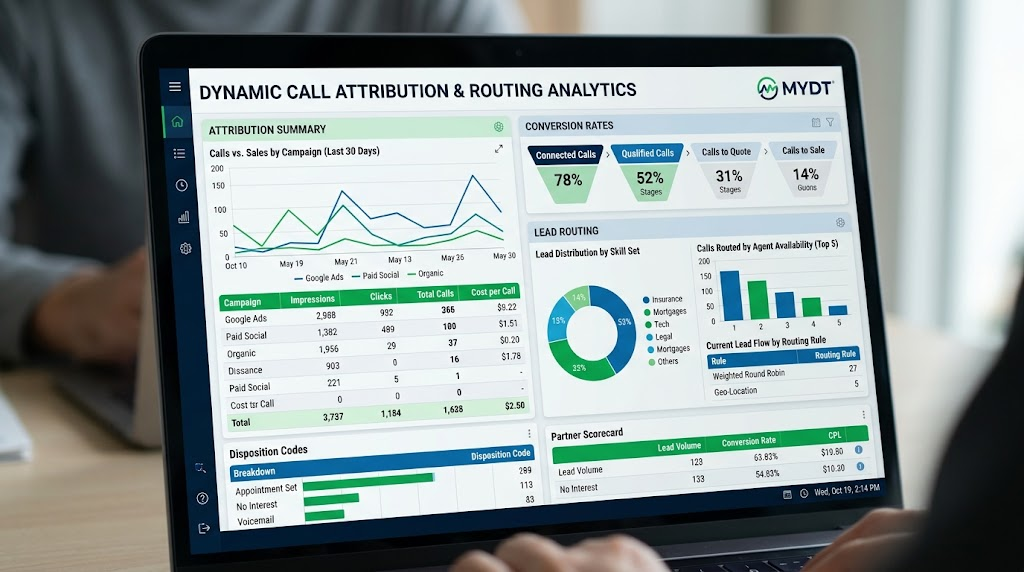
Without tracking, media optimizes to form fills while sales lives on the phone. Budgets drift toward channels that look cheap on forms and away from channels that actually book jobs. With tracking, you can compare cost per connected call, cost per qualified conversation, and downstream close rates by source.
This guide is a buyer’s framework for lead generation operators: what to measure, which capabilities matter, how tools differ, and how to implement without creating reporting fiction. For the operational mechanics of tracking in performance programs, see how call tracking works in lead generation. Here the focus is selection and fit.

What Call Tracking Software Must Do for Lead Gen
At minimum, a system should provision numbers, attribute inbound calls to a source, record duration and basic outcomes, and export data to the systems your team already uses. Lead generation adds harder requirements: multi-partner routing, qualification flags, and clean handoffs to buyers or internal sales.
Dynamic Numbers and Source Attribution
Session-based or campaign-based numbers let you see which keyword group, landing page, or affiliate drove the ring. Static numbers still help for offline or partner channels, but dynamic pools unlock digital optimization.
Call Outcomes Beyond “Answered”
A 10-second hang-up is not a qualified opportunity. Look for disposition codes, duration thresholds, recording access where lawful, and the ability to mark qualified versus unqualified under your campaign rules—especially if you buy or sell pay-per-call leads.
Selection Criteria That Actually Change Results
Feature pages look similar. Decision quality comes from operational fit.
Routing and Concurrency
Can the platform route by geo, schedule, skill, or weighted priority? Can it respect buyer caps so agents are not flooded? Lead gen and PPCall programs fail when calls pile into voicemail during peak intent windows.
Integrations
CRM, ad platforms, analytics, and affiliate or lead platforms should receive consistent postbacks. Manual CSV uploads are fine for pilots, not for scaled optimization.
Reporting Definitions
Confirm how the vendor defines a call, a connected call, and a billed minute. Align those definitions with your contracts before launch. Google’s own documentation on phone call conversion tracking in Google Ads shows how platforms distinguish clicks, calls, and imported outcomes—your internal definitions still need to match what you pay for.
Compliance, Consent, and Recording
Tracking phone activity sits next to consent and recording rules. Number pools, whisper messages, and call recording features must be configured for the jurisdictions you serve. TCPA and related frameworks remain central for U.S. outbound and certain lead-driven contact patterns—see our practical framing in The Federal Communications Commission also maintains consumer and industry resources on robocalls and related rules that operators should monitor as programs scale. TCPA compliant lead generation and delivery standards when leads feed dialer or call workflows.
Software cannot invent missing consent. It can help you document routing paths and preserve records when your process already captures lawful basis to contact. See also the FCC guide on unwanted robocalls and texts.
How to Compare Vendors Without Getting Lost
Run a structured scorecard.
- Attribution model matches your media mix (search, partners, offline)
- Qualified-call and disposition workflow matches campaign terms
- Routing supports hours, geo, and capacity rules
- API or native integrations cover CRM and ad accounts you use
- Reporting exports source-level cost and outcome fields
- Recording, whisper, and notice features fit your legal review
- Pricing model (per number, per minute, per seat) is predictable at your volume
Invite two vendors into a limited pilot with the same campaign types. Compare not only “calls tracked” but time-to-insight for media buyers and time-to-connect for sales. The prettier dashboard loses if operations cannot act on it within the hour.
Implementation Mistakes That Waste the Tool
- Tracking number clicks as if they were qualified conversations
- No shared definition of qualified call between media, vendors, and sales
- Routing to general queues without capacity or skill logic
- Ignoring after-hours intent or failing to schedule callbacks
- Never feeding dispositions back to source optimization
Tooling amplifies process. Weak process with expensive software still produces unmeasured or mismeasured demand. Fix definitions and SLAs in writing before you expand number pools sitewide.
Call Tracking Software Inside a Full Lead System
The best stack connects: high-intent media or partners, tracked numbers on landing experiences, qualified routing, CRM outcomes, and weekly source reviews. Human voice remains a high-trust channel—see pay per call and the power of the human voice for why live conversation still converts when intent is real.
Media DT builds programs where inbound demand is measured and routed for partners who need conversation quality—not just form volume. Software choice is one layer; the operating system around it decides ROI.
When you pilot, freeze definitions for at least two weeks: what is connected, what is qualified, what is sold. Changing labels mid-test makes vendor comparison meaningless. Write the definitions into the pilot brief and share them with sales, media, and any external partners on the same traffic.
Multi-location and multi-brand setups need hierarchy. Agencies and franchise systems should confirm whether the platform supports account trees, role-based access, and rolled-up versus location-level reporting. Buying a single-location tool for a national footprint creates manual work that never ends.
Change management decides adoption. If media buyers cannot see source performance inside the tools they already open each morning, they will keep optimizing to form conversions. Push summaries into Slack, email digests, or the ad platforms they live in. Software that requires a separate login nobody opens will not change spend.
Pricing predictability is part of fit. Per-minute models can surprise teams during seasonal spikes. Per-number models can look cheap until unused numbers accumulate. Seat-based models can constrain who sees reports. Model your peak month, not your quietest week, when you compare quotes.
Data retention and access control matter when recordings and caller metadata are stored. Decide who can listen, how long files remain, and how deletion requests are handled. Sales enablement wants recordings for coaching; legal and compliance want boundaries. Configure roles before rollout, not after a dispute.
Latency and answer rate belong in the vendor conversation. A tracked call that sits in queue for two minutes may still “count” in software while dying in the customer’s patience. Measure time-to-answer and abandon rate beside cost-per-call. Tracking without service levels optimizes a hollow metric.
Number management is more operational than it looks. Pool size must match concurrent sessions or you recycle numbers too quickly and blur attribution. Static numbers still matter for QR codes, print, and partner one-sheets. Plan naming conventions so finance and media can read reports without a decoder ring.
Start from the business question, not the feature matrix. Are you trying to prove which paid search themes drive bookable calls, to police partner quality on a pay-per-call program, or to give internal sales a fair queue with context on the screen? Different questions prioritize different capabilities: granular keyword-level pools, partner-level scorecards, or CRM screen-pops and whisper coaching.
In short, call tracking software for lead generation is infrastructure for accountable conversations. Select for attribution fidelity, routing realism, integration depth, and compliance posture. Implement with shared definitions and sales feedback. Then let source-level economics—not gut feel—decide where the next dollar of media or partner spend goes.
Revisit the stack when your mix changes. Adding affiliates, expanding to new states, or launching pay-per-call buyers introduces routing and reporting needs a simple site-tracking setup may not cover. Schedule a quarterly fit review so software grows with the program instead of becoming a constraint.
Documentation keeps the system alive when people change roles. Maintain a one-page runbook: number pool rules, qualification codes, escalation contacts, and report cadence. Call tracking programs decay when only one person understands the naming scheme.
Benchmarks are directional, not universal. A professional services firm and an emergency HVAC line will not share the same answer-rate targets or average handle time. Build internal baselines by campaign type, then judge vendors and sources against your baselines rather than generic industry averages from unrelated verticals.
Fraud and junk traffic appear on phone channels too. Repeated short calls, mismatched geos, and patterns that never convert deserve the same scrutiny you apply to form spam. Platforms with basic filters help; your dispositions and weekly reviews close the loop.
Offline and hybrid journeys still matter. Missed calls, voicemails, and scheduled callbacks should enter the same pipeline as live connects when your process allows. Otherwise you undercount demand from high-intent callers who rang outside staffing hours. Configure after-hours paths deliberately—overflow, voicemail with SLA, or next-day priority lists.
Train agents on the first thirty seconds. Even perfect attribution fails if the opener ignores the product or city the caller requested. Feed source and landing-page context into the softphone or CRM so conversations start informed. Call tracking software that cannot pass context underuses the data it captures.
Finally, align success metrics with finance. If the company books revenue on installed jobs or bound policies, work backward to the call events that predict those outcomes. Optimize the leading indicators you can influence weekly without pretending every connected call is a sale.
Security reviews belong early. SSO, audit logs, and least-privilege admin roles reduce risk when many users need partial access. Call metadata is sensitive; treat access like CRM access, not like a shared spreadsheet password.
For publishers and affiliates in call programs, tracking transparency is the product. You need to see which traffic sources survive qualification, not only aggregate payouts. Prefer environments where subIDs and publisher IDs survive the full path from click or impression into the call record.
Agencies should clarify data ownership in the contract. Who keeps historical call records if the engagement ends? Can the client export raw events? Portability protects the advertiser when relationships change and prevents hostage data situations.
Procurement teams sometimes over-weight brand familiarity. A well-known logo does not guarantee your qualification workflow or partner caps are supported. Score the pilot outcomes: percentage of calls with complete source data, median time-to-answer, accuracy of CRM writes, and hours spent reconciling reports. Those numbers travel better in a budget meeting than a feature checklist.
When the system is healthy, call tracking software becomes quiet infrastructure: numbers resolve, sources tag correctly, and meetings focus on which channels deserve budget. That quiet is the goal—not a dashboard nobody trusts.
After go-live, protect the first thirty days. Freeze major campaign structure changes so attribution has a chance to stabilize. Use that window to train staff, validate CRM fields, and confirm that billed amounts match your understanding of the pricing model.
Build a short internal RFP even if you only evaluate two tools: required integrations, must-have routing rules, compliance constraints, volume assumptions, and three pilot KPIs. Vendors respond more clearly when the brief is specific, and your team debates less about subjective “ease of use” without shared criteria.
Do that well, and inbound phone demand stops being a mystery channel and becomes a managed part of lead generation.
Choose call tracking software the way you choose any performance infrastructure: by the decisions it enables under real volume, real staffing, and real compliance constraints.
Software supports the workflow; policy and process still set the boundaries of lawful contact.
U.S. teams should also stay current on federal consumer protection resources related to telemarketing and robocall enforcement when designing call-heavy acquisition programs.
Ready for Measurable Inbound Calls and High-Intent Leads?
Choosing call tracking software is how you make phone demand accountable. Pair the right tool with clear qualification rules and sources that actually produce purchase-ready conversations.
Ready for high-intent leads that sales actually wants?